
NPT and NPTF Compatibility: Why Thread Engagement Does Not Prove a Seal
May 30th 2023
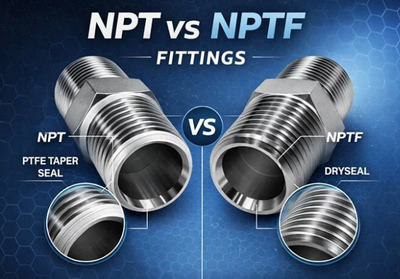
NPT and NPTF fittings can have the same nominal size, pitch, taper, and 60-degree thread form. That physical similarity sometimes allows mixed parts to engage, but engagement alone does not establish a reliable or specification-compliant seal.
The important difference is the way thread tolerances and crest-root contact are controlled. NPT normally uses a suitable thread sealant. NPTF is a Dryseal thread intended to reduce the spiral leakage path through more controlled interference. Whether a mixed joint is permitted must come from the equipment and component specification, not from a bench trial.
Two standards create different acceptance criteria
ASME B1.20.1 covers general-purpose inch pipe threads including NPT. Tapered male and female threads wedge as they tighten, but small clearances can leave a helical path. An approved paste or tape fills that path and may provide lubrication during assembly.
ASME B1.20.3 covers Dryseal pipe threads including NPTF. Additional control of crest and root truncation promotes metal contact that interrupts the leakage path. The word “dry” describes the thread design; it does not cancel a product manufacturer’s assembly instructions or the needs of a particular fluid service.
These distinctions are difficult to confirm visually. A part that looks like NPTF may be ordinary NPT, damaged, coated, or out of tolerance. Markings, drawings, gauges, and traceable part numbers are more dependable.
Evaluate every male-female combination separately
An NPT male may screw into an NPTF female, and an NPTF male may enter an NPT female. The resulting contact pattern, hand-tight engagement, wrench position, and leakage behavior may not match a same-standard pair. Sealant can improve some mixed NPT/NPTF assemblies, but it does not make them universally approved.
Avoid mixed use where an OEM drawing specifies one thread, leakage consequences are high, disassembly is frequent, cleanliness limits sealant, or inspection must follow a defined gauge standard. Fuel, high-pressure hydraulic, safety-related, and controlled production systems deserve documented compatibility rather than an informal substitution.
If the installed port cannot be changed, the safer answer may be an explicitly rated adapter or the correct same-standard replacement. Do not “upgrade” one side to NPTF without reviewing the other side and the governing specification.
The practical risks appear after assembly
Mixed or misidentified tapered threads can leak, seize before adequate engagement, or accept excessive turns. Additional torque may damage the first engaged threads, gall stainless steel, or crack a female casting or manifold. A seal that passes an initial static check can still respond differently to heat, pressure cycles, and vibration.
Sealant adds another variable. Too little may leave a path; too much can enter the circuit or prevent inspection. PTFE tape applied across the first thread can shed fragments. A paste compatible with one fluid may not be appropriate for another.
Reuse changes both surface contact and engagement. Before reassembly, inspect deformation, corrosion, galling, old compound, and the position at which the joint previously tightened. Replacing sealant does not restore damaged geometry.
Identification needs more than a pitch gauge
First confirm that the thread is tapered rather than straight. Measure major diameter at more than one axial position and use a thread-pitch gauge. Check nominal size against a reliable NPT/NPTF table, remembering that nominal pipe size is not the measured OD.
Next look for stamped or catalog identification and consult the equipment bill of material. Differentiating NPT from NPTF typically requires the specified gauges and inspection method; unaided visual examination cannot validate Dryseal tolerances.
Also rule out BSPT. It uses a 55-degree Whitworth form and different pitch/diameter relationships. A BSPT part can sometimes begin in an NPT port, creating the same false confidence as an NPT/NPTF assumption but with more fundamental mismatch.
Install the specified pair under one procedure
Clean male and female threads without pushing debris into the system. Use only the type and quantity of sealant authorized for the media, material, temperature, and application. Start by hand to detect cross-threading. Apply the documented tightening method rather than searching for a universal torque number.
Pressure-test safely and inspect the true joint boundary. Never use a hand to find a high-pressure hydraulic leak. If the fitting stops unexpectedly, must be backed off for orientation, or needs unusual torque to stop seepage, depressurize and diagnose rather than continuing to turn it.
For replacements, preserve the exact thread designation from the drawing or verified part number. If documentation is unavailable, record both mating components and have the thread identified with proper gauges.
NPT and NPTF belong to the same tapered pipe-thread family, but they are not blanket substitutes. A controlled joint uses a known male, known female, compatible sealant practice, and acceptance criteria appropriate to the service.