
Identifying and Installing SAE O-Ring Boss Port Fittings
HGW Hydraulics on May 17th 2023
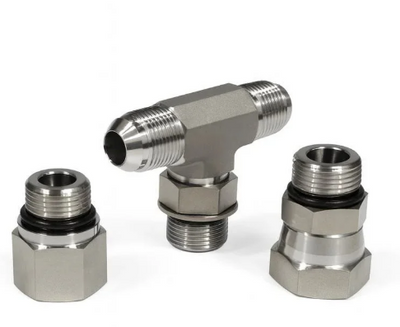
SAE O-Ring Boss is a port connection built around a replaceable elastomer seal. The male fitting’s straight thread supplies clamping force; an O-ring near the shoulder compresses against the port entrance to contain fluid. Keeping those jobs separate makes ORB easier to identify, install, and diagnose than a connection judged only by thread appearance.
ORB commonly appears in hydraulic manifolds, pumps, valves, cylinders, mobile equipment, industrial power units, and some automotive fluid systems. Its presence does not establish the pressure or fluid capability of an assembly. Those limits come from the exact port, fitting, material, seal, and governing equipment specification.
What the SAE port controls
SAE J1926 covers straight-thread O-ring boss ports and associated connection dimensions. A female port includes a straight internal thread, a lead-in chamfer, and a sealing area that supports controlled O-ring compression. The male fitting includes a matching UN/UNF thread and an O-ring groove positioned near the base.
Straight threads do not tighten by taper interference. When the fitting reaches its installed position, the O-ring is compressed between the male groove region and port sealing geometry. That is why pipe-thread sealant is not the normal seal for ORB and why damage at the chamfer can matter more than a cosmetic mark farther down the thread.
Adjustable elbows and tees add a locknut and backup washer. They allow the body to be oriented while the stud end remains sealed. Nonadjustable adapters are installed to their defined seating condition without that orientation mechanism.
Recognize ORB among look-alike ends
On a male ORB end, look for parallel threads and an O-ring at the shoulder. A male JIC end normally presents a 37-degree flare cone instead. ORFS places its O-ring in a groove on a flat face. NPT has a visible taper and relies on the threaded region for sealing.
The female port requires closer inspection. Confirm that the thread is straight, measure its diameter and pitch, and look for the correct entrance chamfer. A straight threaded hole could belong to another standard and may use a bonded washer, face seal, or different seat.
Never add an O-ring to an arbitrary straight-thread fitting and call it ORB. Groove dimensions, compression, surface finish, and port shape form the sealing system.
Interpret dash sizes with a chart, not a ruler alone
ORB is commonly described by dash size. Dash numbers often relate to tube or hose size conventions, but they must be converted to the specified SAE thread using an authoritative chart. The thread outside diameter is larger than the nominal fluid size, so a caliper reading will not look like the dash fraction.
Measure a clean male thread across its crests and determine threads per inch with a pitch gauge. For a female port, measure carefully and avoid treating an approximate caliper value as final. Confirm the O-ring size and material separately; a seal that stretches into the groove is not necessarily correct.
When replacing an unknown end, document the mating component, equipment model, port callout, orientation, fitting material, tube or hose size, and opposite connection. A clear photograph of the port entrance and stud end can prevent confusion with metric straight-thread ports.
Prepare the seal before turning the fitting
Depressurize and clean the system using the required procedure. Inspect the port for burrs, radial scratches, corrosion, thread damage, and debris. Check the male groove and threads. Install a new specified O-ring if the existing seal is damaged, flattened, swollen, hardened, or of uncertain identity.
Use a lubricant only when permitted and compatible with the fluid and elastomer. It can reduce twisting and cutting during installation, but an unsuitable product can contaminate the circuit or attack the seal.
Start the fitting by hand. Resistance at the first turns suggests cross-threading or a mismatch. For an adjustable fitting, follow the specified sequence for locknut, washer, orientation, and final tightening. Support connected hose or tube so the port is not used as a structural bracket.
Match O-ring compound to service
Nitrile is common in many petroleum-based hydraulic applications, but that does not make it universal. Temperature, synthetic fluids, water-glycol mixtures, fuels, aggressive chemicals, and external exposure may require another compound. Verify compatibility using the equipment and seal supplier data.
Fitting material also matters. Carbon steel, stainless steel, and other alloys respond differently to corrosion, galling, and the surrounding component. Avoid assuming stainless prevents all corrosion or that a stronger material allows greater system pressure without supporting ratings.
Failure patterns reveal the assembly error
A shaved or pinched O-ring often indicates poor alignment, a sharp port edge, dry assembly, or incorrect size. Extrusion can point to excessive clearance, wrong seal, damage, or service beyond the approved condition. A hardened or cracked seal suggests aging, temperature, or incompatibility. Uneven witness marks may expose side load or a damaged chamfer.
If a leak appears, locate its true source before tightening. Fluid may travel from a nearby hose end or manifold joint. Once depressurized, inspect the O-ring and port and compare the installed fitting with the documented part. Adding tape to ORB threads hides evidence and does not restore the port seal.
ORB selection becomes reliable when the port standard, dash size, O-ring compound, fitting configuration, material, and service conditions are all recorded. The connection’s apparent simplicity is the result of controlled geometry, not permission to mix any straight threads that seem to fit.