
Use ORB for a Boss Port and JIC for a 37 Degree Line Connection
Aug 9th 2023
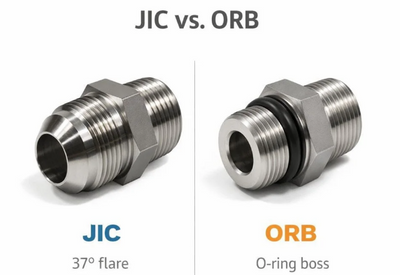
ORB and JIC frequently appear next to each other because a pump, valve, or manifold can have an O-ring boss port while the connected hose ends in a JIC swivel. The two fittings may use related straight-thread sizes at several dash sizes, but they perform different jobs and cannot seal by thread compatibility alone.
The simplest distinction is physical: ORB seals an adapter into a machined boss port with an O-ring; JIC seals a line connection where two 37-degree metal surfaces meet.
Read an ORB end from the port outward
An SAE ORB male stud has straight threads, an O-ring in a controlled position, and geometry that loads the seal at the port entrance. The female port provides matching threads, chamfer or seal support, and a spotface. The threads retain the adapter rather than sealing the fluid.
Fixed stud ends and adjustable stud ends are assembled differently. Adjustable elbows and tees often use a locknut and backup washer so the body can be positioned without another full turn. Follow the manufacturer’s procedure for seal lubrication, orientation, engagement, and tightening.
ORB performance depends on correct O-ring size and compound. Petroleum fluid, water-glycol, phosphate ester, temperature, decompression, and external chemicals can require different elastomers. The port face and chamfer must be clean and free from corrosion or scratches.
Read a JIC end from the seat outward
JIC uses a male 37-degree cone and mating female flare. Straight threads and the nut pull the faces together. There is no O-ring at the flare seal, and pipe-thread tape or paste should not be applied in an attempt to improve that metal seat.
Confirm dash or tube size, thread diameter and pitch, seat angle, and condition. A 45-degree flare, Japanese 30-degree connection, or another straight-thread family may engage but will not provide the intended JIC contact. Side load, tube preparation, and hose twist can also prevent even seating.
Do not rank the two from one pressure claim
Neither ORB nor JIC has one pressure rating that applies to every size, material, and product. Finished-component geometry, standard, manufacturer data, temperature, and the mating part establish capability. An elastomeric port seal can serve demanding circuits, and a properly manufactured 37-degree flare can also provide reliable hydraulic service.
ORB is not automatically more consistent at all pressures, and JIC is not automatically a medium-performance connection. The equipment designer may choose ORB for compact ports and adjustable orientation, while using JIC where a hose or tube must be disconnected. Leakage risk comes from the complete selection and assembly, not from a universal ranking of the two names.
Identify the part from the sealing feature
On a male end, an O-ring near the straight threads points to ORB; a protruding 37-degree cone points to JIC. On the female side, ORB is a threaded boss port with an entrance seal area, while female JIC has a concave flare seat and typically a nut or swivel arrangement.
Use calipers, pitch gauges, and a seat-angle gauge when the part is worn or unfamiliar. Dash numbers can correspond to related thread sizes, which is precisely why thread-only identification is unsafe. Record the port and line ends separately.
Transition through an intentional adapter
An ORB-to-JIC adapter is a normal way to connect a boss port to a 37-degree hose or tube end. One side carries the specified ORB seal; the other presents the correct JIC flare. Select the adapter by both end sizes, body shape, material, working rating, seal compound, and required orientation.
Avoid adding several adapters simply because each pair of threads fits. Extra joints add length, leverage, flow restrictions in some geometries, inventory, and potential leak points. A direct adapter that meets both interfaces can simplify routing, provided it does not place the hose in twist or below minimum bend radius.
Diagnose ORB and JIC leaks differently
For ORB, inspect the O-ring for cuts, extrusion, flattening, swelling, hardening, or incorrect size. Check the groove, backup washer, locknut, chamfer, spotface, thread engagement, and port depth. Installing two O-rings or adding sealant to the straight threads is not a repair.
For JIC, inspect the complete circumference of both flare surfaces for scratches, dents, corrosion, contamination, and uneven witness marks. Check the tube flare, sleeve or hose end, alignment, vibration, and side load. More torque can damage the seat and conceal a mismatch temporarily.
Always isolate pressure before inspection. Oil can travel from a nearby source, so clean and observe the connection rather than assuming the visible joint is the origin. Preserve damaged parts when a repeated or consequential failure requires review.
Control material, torque, and reuse
Both families are available in carbon steel, stainless steel, and other materials. Select alloy or coating for internal fluid, external corrosion, temperature, galling, and mating material. The O-ring remains a separate material decision on ORB.
Use size- and product-specific installation instructions. Torque changes with thread size, fitting design, material, coating, lubrication, seal arrangement, and port strength. Reassembly may be possible when the hard parts remain within specification, but replace service seals as required and reject damaged flare faces or port geometry.
Order the function, not a familiar dash number
A complete purchase description states ORB or JIC, dash size, actual thread where needed, male or female end, seal geometry, O-ring compound for ORB, material, body shape, orientation, pressure and temperature, fluid, and the opposite connection.
That information lets ORB and JIC work together without being confused. The boss port receives the elastomeric seal it was machined for, the removable line receives the 37-degree seat it needs, and the adapter between them is a controlled component rather than an improvised thread match.