
ORB or NPT Port Connections: Choose by Seal Location and Service Needs
HGW Hydraulics on May 11th 2023
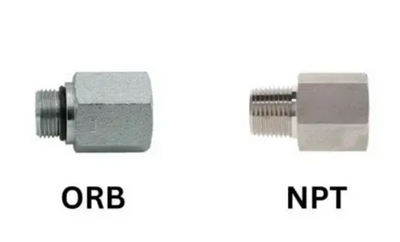
ORB and NPT are both used to connect fittings to ports, but they control leakage in different places. An SAE O-Ring Boss connection uses straight threads to retain the fitting and an O-ring at the port to seal. National Pipe Taper relies on tapered thread interference, normally with an approved sealant.
That distinction affects installation, reuse, orientation, and troubleshooting. The better choice is the standard designed into the component—not whichever end begins to thread into the hole.
Start at the fluid boundary
On an ORB male, the O-ring sits near the base of a UN/UNF straight thread. It compresses against the chamfer and sealing area of a compatible port. Because the thread does not wedge, the sealing function can be inspected and renewed by replacing the correct O-ring when the fitting and port remain serviceable.
An NPT male and female have matching 60-degree tapered pipe threads. Engagement creates increasing interference along the flanks. An appropriate sealant fills the helical leakage path and small surface gaps. The thread itself therefore participates in retention and sealing.
The two systems do not become interchangeable because an adapter exists. A conversion fitting has a correctly engineered ORB end on one side and NPT on the other; each side must be assembled according to its own method.
Installation changes the service outcome
An ORB connection normally starts freely by hand until the O-ring approaches the port. The seal should be clean, compatible, undamaged, and lubricated only as specified. Nonadjustable fittings are tightened to the prescribed position. Adjustable elbows and tees use a locknut and backup washer arrangement so the fitting can be oriented without asking the O-ring to hold an arbitrary thread position.
NPT assembly requires clean, correct threads and controlled sealant application. Tape or paste must not obstruct the fluid passage. Because tightening advances the taper, excessive torque can deform threads, gall stainless steel, or crack a female port. Backing off a tapered fitting to obtain elbow orientation can also disturb the seal.
Neither connection should be tightened by intuition alone. Follow the component or fitting manufacturer’s method and consider material, plating, lubrication, size, and port construction.
Serviceability is more than reuse count
ORB is often convenient where machinery is disassembled regularly: the sealing element is visible and replaceable, and adjustable fittings can be clocked without changing the primary seal. Reuse still requires inspection of the groove, threads, washer, locknut, port chamfer, and fitting body.
NPT can be economical and widely available in stationary plumbing, air, lubrication, and appropriate hydraulic service. Repeated assembly changes thread engagement and sealant condition, however. A reused tapered port can eventually tighten at a different position or lose usable thread.
Vibration does not make every ORB joint safe or every NPT joint unsuitable. Actual component ratings, hose loads, support, pressure cycles, and maintenance determine reliability. ORB’s elastomeric port seal often offers a clearer and more repeatable leakage boundary in serviced hydraulic equipment.
Identify the port before choosing the adapter
Look for taper first. NPT diameter changes along its thread length; ORB remains parallel. On a male fitting, an O-ring groove at the base strongly suggests ORB, while an NPT end has no port-sealing O-ring. On a female port, ORB normally includes an entrance chamfer and controlled sealing surface.
Measure thread diameter and pitch with the correct tools, then verify against the equipment drawing or a reliable standard chart. Pipe nominal size does not equal measured outside diameter. ORB dash size also should not be inferred from wrench size.
A used part may be misleading if its O-ring is missing or its pipe threads are worn. Record both mating sides, equipment model, and visible markings before approving a replacement.
Read failures from their location
An ORB leak near the port can result from a cut, extruded, flattened, heat-damaged, or chemically incompatible O-ring; a scratched chamfer; debris; an incorrect seal size; or side load. Adding thread sealant to the straight threads does not repair those conditions.
An NPT leak may involve insufficient or incompatible sealant, wrong engagement, damaged or mismatched threads, galling, cracking, or movement after assembly. Applying more torque without inspecting the female component can make the failure permanent.
When the port and required hose end use different standards, specify a purpose-made adapter with adequate material and application suitability. Avoid stacked adapters where one correct combination can reduce leak paths and load.
Make the choice at design and replacement stages
For new hydraulic equipment that needs repeatable port sealing, frequent service, or oriented elbows, ORB may offer practical advantages. For an existing NPT manifold or an appropriate static utility line, retaining the designed pipe-thread connection may be correct. The final decision still includes media, temperature, pressure, vibration, corrosion, component availability, and the governing specification.
The most expensive error is not choosing the less fashionable standard. It is installing a familiar fitting into a port whose sealing geometry was never identified. ORB and NPT perform predictably when each is used as a complete connection system.