
ORFS Connections: Face-Seal Geometry, Identification, and Leak Diagnosis
HGW Hydraulics on May 2nd 2023
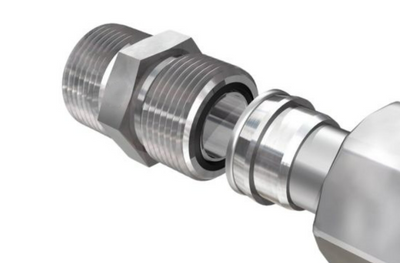
An O-Ring Face Seal connection separates the clamping function from the sealing surface. Straight threads draw a flat male face against the female end, while an O-ring captured in the male face provides the seal. This geometry is the reason ORFS is common in hydraulic systems exposed to pressure cycling and vibration.
The benefit depends on correct parts and assembly. A flattened face, missing or incompatible O-ring, contaminated groove, or mismatched thread can still produce a leak. Treat ORFS as a defined connection system rather than a generic “O-ring fitting.”
Trace the load path through the connection
The male ORFS end has straight threads, a flat face, and an annular groove containing an O-ring. The female swivel has matching threads and a flat sealing face. Tightening the nut clamps the faces and compresses the elastomer within a controlled space.
The threads provide axial force but are not the primary fluid seal. Pipe-thread tape or paste on a normal ORFS thread does not improve the face seal and may contaminate the system. The condition of the groove, O-ring, and opposing face matters far more.
SAE J1453 and ISO 8434-3 address ORFS connection requirements. A purchase drawing should identify the applicable standard, size, material, end configuration, and seal rather than relying on the letters ORFS alone.
Identify the sealing face before measuring the thread
Start by cleaning the end and viewing it squarely. A male ORFS end shows an O-ring set into a groove on a flat face. The female end normally has a flat face inside a swivel nut. This differs from the exposed 37-degree cone of JIC, the port-mounted O-ring of ORB, and the tapered thread of NPT.
After recognizing the sealing geometry, measure thread outside diameter and pitch with suitable gauges. Confirm the dash size from a reliable chart or drawing. Similar diameters are not proof of compatibility, and forcing the wrong thread can damage both the nut and body.
Do not identify a used connection by the O-ring alone. Some parts lose their seal during disassembly, and other standards also use elastomers. The face shape, groove location, thread, and intended mate must agree.
Why ORFS is useful in moving equipment
Proper O-ring compression can accommodate small surface variation without requiring the metal cone contact used by a flare fitting. The flat face is easy to inspect, and the swivel nut allows assembly without rotating the hose. These characteristics support service in mobile machinery, industrial hydraulic equipment, and other circuits with pressure impulse.
ORFS also has limits. The exposed face and O-ring must remain clean during storage and installation. The elastomer must suit fluid and temperature. Space, cost, existing port standards, and availability may favor another connection. ORFS should not be selected merely because the system pressure sounds high; the rating of the exact components and assembly controls.
Distinguish ORFS from nearby fitting families
A JIC connection seals where matching 37-degree metal flares contact. It has no face O-ring. ORB uses a straight thread into a port and seals with an O-ring at the port chamfer; it is a port connection rather than the same flat-face union geometry. NPT uses tapered threads and normally an approved sealant.
These families can coexist in one machine through purpose-designed adapters. They should not be made to mate directly based on approximate thread engagement. A correct adapter preserves each side’s intended sealing method.
Assemble for an undamaged face seal
Cap open ends until installation. Inspect both faces for dents, radial scratches, corrosion, embedded particles, and old seal material. Replace the O-ring with the specified size and compound; do not reuse one that is cut, flattened, swollen, hardened, or of unknown identity.
Use only the specified compatible lubricant, if required. Keep the O-ring in its groove while starting the nut by hand. Support the fitting body and tighten using the applicable manufacturer or equipment procedure. Rotating a loaded hose or using extra torque to overcome misalignment can damage the seal and shorten hose life.
After assembly, pressure-test using the system’s safe procedure and inspect without placing hands near a suspected high-pressure leak. If seepage appears, depressurize before investigation.
Diagnose by evidence, not by adding torque
An immediate leak after service often points to a missing, pinched, contaminated, or wrong O-ring; a damaged face; a loose joint; or the wrong counterpart. A leak that returns after cycling may involve hose load, vibration, face damage, seal compatibility, or loss of clamp support.
Record where the leak originates. Fluid traveling along a hose or adapter can make a port leak appear to come from the ORFS face. Examine witness marks on both faces, verify part numbers and thread size, and check routing before replacing pieces at random.
For repeat purchasing, retain connection size, material, seal compound, hose series, end orientation, and equipment location. Those details let a replacement preserve the engineered seal rather than merely reproduce the outside appearance.
ORFS works well when its three functions remain distinct: threads clamp, faces align, and the O-ring seals. Identification and troubleshooting become much clearer once every observed feature is assigned to the correct function.