
ORFS Hose Connections and ORB Ports Solve Different Sealing Jobs
Aug 22nd 2023
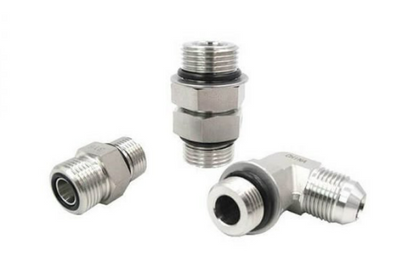
ORFS and ORB are often placed in a side-by-side “which is better” comparison, but they commonly occupy different positions. ORFS joins a hose or tube end across two flat faces. ORB installs a fitting stud into a machined port. A system may use ORFS on the line and ORB at the valve or manifold through the same adapter.
The useful decision is therefore where each seal belongs, how it will be serviced, and whether the component geometry supports it—not a single winner for the whole circuit.
ORFS contains fluid across a flat face
Under SAE J1453, a male ORFS end has straight threads and an O-ring captured in a groove on its flat face. A female swivel brings a matching flat face against it. Tightening creates axial O-ring compression around the circumference.
The thread supplies clamp force and should not receive pipe-thread tape as a sealing substitute. Common ORFS dash sizes pair with specific UN/UNF threads, but the exact size must be confirmed from the standard or manufacturer chart.
The face is easy to inspect and the swivel permits assembly without turning the hose body. These features support mobile and industrial lines exposed to pressure cycling and vibration. The exposed O-ring and face must be capped and kept free of dents and debris.
ORB seals a fitting inside a port entrance
SAE J1926 and related ISO requirements cover O-ring boss port geometry. A male ORB stud has straight threads and an O-ring near its shoulder. During installation, that seal compresses against the port chamfer and controlled sealing area.
The port machining is part of the joint. A correct male thread cannot compensate for a scratched chamfer, burr, wrong groove, or distorted entrance. Adjustable elbows and tees use a backup washer and locknut arrangement so the body can be oriented while preserving the port seal.
ORB dash sizes also pair with defined UN/UNF threads, but the pairings differ from ORFS. For example, a dash number does not mean the two standards share the same thread. Identify the complete end.
Their O-rings see different compression geometry
ORFS compresses the face O-ring axially between flat surfaces. ORB creates compression around the stud at the port. Both can provide reliable hydraulic sealing when dimensions, elastomer, surface condition, and tightening are correct.
It is too broad to claim that every ORFS connection tolerates vibration better than every ORB port or that ORB is only for low-vibration service. Hose load, clamps, component ratings, port quality, pressure cycles, and equipment design determine performance. ORFS does offer an inspectable line-to-line face, while ORB offers a compact standardized port interface.
Neither thread itself is the normal fluid seal, and neither receives a universal pressure rating based on its acronym.
Selection often creates an ORFS-to-ORB adapter
Consider a manifold with an ORB port connected to a replaceable hose. An adapter can place the specified ORB stud into the manifold and present a male ORFS face to the hose swivel. The machine then receives the service and routing benefits of both standards.
Changing the ORB port to ORFS would require a different component design; changing the hose swivel to ORB would not create a normal line union. This is why comparing the ends only by cost or published pressure misses their roles.
Review space, orientation, wrench access, hose bend radius, adapter length, material, corrosion exposure, fluid, temperature, and documentation. One purpose-made body is preferable to a long stack of converters.
Diagnose each seal at its own boundary
An ORFS leak can come from a missing, cut, flattened, or incompatible face O-ring; a scratched flat; contamination; misalignment; or incorrect tightening. An ORB leak can involve the stud O-ring, port chamfer, adjustable locknut procedure, side load, or a wrong straight-thread standard.
Do not add tape to either thread. Depressurize, clean the area, inspect witness marks, verify part identity, and replace seals only with the specified size and compound. Follow the authorized lubricant and tightening instructions.
Specify the whole connection path
For ORFS, record dash size, male or female face, seal compound, material, hose or tube end, and opposite connection. For ORB, record dash size, port standard, adjustable or nonadjustable stud, locknut components, seal, and body orientation.
ORFS and ORB are complementary tools in many hydraulic layouts. Reliability improves when the flat-face union and boss port are each used where their geometry was intended, then connected through a controlled adapter rather than treated as competing names.