
ORFS Connects Two Line Ends; ORB Terminates at a Component Port
HGW Hydraulics on Nov 30th 2021
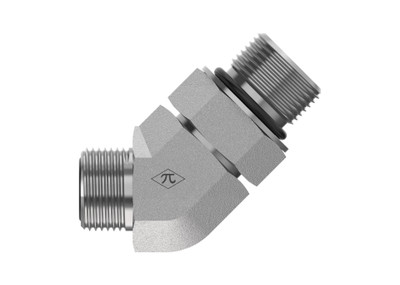
ORFS and ORB both use straight threads and an O-ring, but they solve different interface problems. ORFS joins two line ends across flat faces. ORB installs a fitting into a machined component port. Confusing them can put the correct thread next to the wrong seal.
ORFS seals at the end face
An ORFS male has an O-ring groove in its flat face. The female swivel or tube end presents a flat mating surface. Tightening the nut compresses the O-ring axially while threads maintain clamping.
Inspect the male groove, face, O-ring, female face, sleeve or formed tube end, and nut. Scratches across the seal path or a twisted, cut, swollen, or hardened O-ring can leak.
SAE J1453 and ISO 8434-3 define ORFS connection requirements within their scopes. Pressure and temperature ratings vary with size, material, tube/hose, seal compound, and manufacturer. The design is not infinitely reusable and does not guarantee zero leakage.
ORB seals inside a port chamfer
An ORB male carries an O-ring near the shoulder. The female component port has a straight thread, chamfer, and spotface. As the fitting enters, the O-ring is compressed radially/axially in the defined port geometry.
Straight connectors and plugs can be non-adjustable. Elbows and tees may use a locknut and backup washer so the body can be oriented before final sealing. Follow the assembly sequence; bottoming the fitting or backing a fixed body out to aim it can damage the joint.
Inspect thread length, chamfer, spotface, O-ring, backup parts, and wrench clearance. An O-ring groove in the female port is not the generic definition of ORB.
O-ring selection applies to both interfaces
Choose the exact size and compound for fluid, temperature, pressure, decompression, and environment. NBR and FKM are common options in many oil services; EPDM, silicone, FFKM, polyurethane, and others have different compatibility and mechanical limits.
Base fitting material does not override the elastomer limit. Stainless bodies can tolerate some environments while the installed O-ring remains the controlling temperature or chemical component.
Use only the approved lubricant and keep sealing surfaces clean. Color is not reliable compound identification.
Measurement follows different evidence
For ORFS, measure thread diameter and pitch, face size, tube or hose size, and inspect the flat seal geometry. For ORB, measure port thread and confirm chamfer/spotface plus adjustable or fixed configuration.
Do not choose between them merely from wrench clearance. The system design determines whether the needed interface is line-to-line or fitting-to-port.
Adapters can include both
An ORFS-to-ORB adapter is common because it places an ORB stud in a valve or manifold and offers an ORFS face to a hose or tube. It contains two separate O-ring seals. Record compound, size, orientation, rating, and assembly method for each.
Avoid stacking adapters where one controlled body can provide the transition. Extra length increases restriction and bending load at the component port.
ORFS and ORB are easiest to distinguish by asking what the O-ring presses against: a flat opposing face for ORFS, or a chamfered component port for ORB. That location controls inspection, assembly, and replacement.