
Passivating Machined Stainless Parts: Cleaning, Acid Treatment, Rinsing, and Verification
HGW Hydraulics on Aug 21st 2024
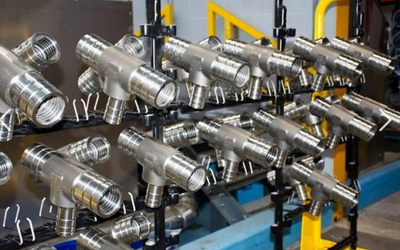
Stainless steel already depends on a chromium-rich passive film for corrosion resistance. Machining, grinding, forming, welding, and handling can leave free iron, shop soil, scale, or heat tint on that surface. Passivation is a controlled chemical treatment used after proper cleaning to remove susceptible contamination and support a clean passive condition.
It is not a plating layer and it cannot repair the wrong alloy, deep corrosion, defective weld, or damaged dimension. The process must match the stainless grade, part geometry, surface condition, and governing specification.
Separate cleaning, descaling, and passivation
Oil, coolant, grease, marker, polishing compound, and dirt must be removed before an acid bath can contact the metal uniformly. An alkaline or solvent cleaning step may be appropriate under the process specification, followed by thorough rinsing.
Heavy oxide scale and welding heat tint may require pickling or mechanical treatment. Passivation alone is not intended as a universal descaling process. Abrasive methods also need contamination control so carbon-steel particles are not embedded again.
Only after the surface is clean can the selected chemistry remove free iron and promote the chromium-rich passive boundary.
Citric and nitric processes are controlled recipes
Citric-acid processes can chelate free iron and are used in many medical, food-equipment, aerospace, electronic, and general industrial workflows. They can offer handling and waste-treatment advantages, but effectiveness depends on concentration, temperature, time, solution control, and the stainless grade.
Nitric-acid processes have a long industrial history and provide strong oxidizing conditions. They require rigorous ventilation, personal protection, chemical handling, and disposal controls. Some older formulations used dichromate additions; environmental and safety requirements can limit or replace those processes.
ASTM A967/A967M provides passivation treatment and test options for stainless parts. ASTM A380/A380M addresses cleaning, descaling, and passivation practices. The purchase specification should state the required standard, treatment, acceptance test, and any restrictions rather than say only “passivate.”
The passive film is extremely thin
Chromium in the alloy reacts with oxygen to create a thin oxide-rich surface. Passivation removes free iron that could rust and disrupt local behavior; it does not deposit a thick protective shell. Because the layer is thin, final dimensions normally should not be changed like an electroplated buildup, but the chemical process can still attack an unsuitable alloy or poorly controlled surface.
Oxygen exposure after treatment supports passive-film formation. Clean handling and storage prevent recontamination before the part reaches service.
A practical process follows five gates
First, verify alloy and condition. Mixed 304, 316, free-machining, precipitation-hardening, and other grades may not share one treatment window. Second, clean and rinse until the surface is water-break-free or meets the defined cleanliness criterion.
Third, immerse or expose the part using the validated acid concentration, temperature, and time. Agitation, racking, blind holes, threads, and trapped air affect contact. Fourth, rinse thoroughly with controlled water and neutralize where the process requires. Residual acid can stain, corrode, or contaminate service.
Fifth, dry without water spots or dirty air and protect the part from carbon-steel contact. Tanks, baskets, pumps, rinse stations, drying equipment, monitoring instruments, and automation all need compatible materials and maintenance.
Inspection verifies the requested outcome
Depending on ASTM or customer requirements, verification can include water-immersion, high-humidity, salt-spray, copper-sulfate, ferroxyl, or other specified tests. Not every test is suitable for every stainless grade or product. Visual appearance alone does not prove removal of free iron.
Process records can include bath chemistry, temperature, exposure time, solution age, lot identity, rinsing, and test result. For hydraulic fittings, protect threads, flare seats, O-ring grooves, and internal cleanliness throughout processing and inspection.
Common failures start before the acid bath
Persistent rust staining can result from dirty tooling, inadequate cleaning, mixed-metal baskets, contaminated rinse water, incomplete descaling, or recontamination after treatment. Overly aggressive chemistry or excessive exposure can etch the surface or create dimensional and appearance problems.
Passivating carbon steel has a different meaning; paints, conversion coatings, inhibitors, oils, or other protective systems are used because it does not form the same chromium passive film.
Chemical processing requires trained personnel, compatible PPE, ventilation, spill control, and legal waste treatment. Recipe changes should be validated, not improvised at the tank.
Passivation succeeds when it is the final controlled step in a clean manufacturing chain. Alloy verification, surface preparation, validated chemistry, complete rinsing, protected drying, and specified testing create the result—not the acid name by itself.