
Choose Brass or Polymer PEX Fittings from Bore, Water Chemistry, and Listing
Nov 14th 2023
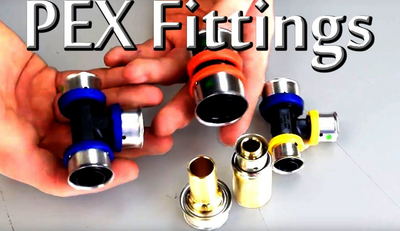
Brass and polymer insert fittings can both be correct for PEX piping. The choice is not a contest between metal strength and plastic price. It depends on the joining system, actual flow passage, water chemistry, temperature and pressure, exposure, local code, and the product listing for the intended service.
Identify the PEX joining system first
PEX is cross-linked polyethylene tube used in water distribution, hydronic heating and cooling, snow-melting, fire-sprinkler, and other approved systems. Fittings may use crimp rings, clamps, cold expansion, press sleeves, push-to-connect mechanisms, compression, or threaded transitions.
These methods require particular tube, fitting geometry, ring or sleeve, tool, and dimensional check. A brass crimp insert commonly associated with ASTM F1807 is not automatically interchangeable with a polymer insert made to ASTM F2159, and neither description covers every PEX connection system.
Use the tubing and fitting manufacturer’s compatibility information plus the applicable plumbing or mechanical code. Potable-water and fire-protection uses can require specific listings and materials.
Compare the actual internal passage
Insert fittings reduce the flow path relative to the tube bore to some degree. Polymer designs may use a thicker wall than a metal fitting for strength, which can reduce bore in certain sizes and product families. The effect on the complete system depends on actual dimensions, number of fittings, tube length, flow demand, and layout.
Do not assume every brass part flows better or that every polymer network creates a meaningful restriction. Obtain pressure-loss or dimension data for the selected product and evaluate the most demanding fixture or circuit. Expansion-style systems and larger sizes can produce different results from a small crimp insert comparison.
Evaluate brass against the water chemistry
Brass can provide compact geometry, mechanical robustness, threaded transitions, and broad service familiarity. Alloy composition matters. Water chemistry, temperature, disinfectants, chloride, pH, alkalinity, and stagnation can contribute to corrosion or dezincification in susceptible brass.
Where potable-water rules apply, use products that meet the required lead-content and health-effects listings. Dezincification-resistant alloy claims should be supported by the exact product documentation. A yellow metal appearance does not reveal composition or compliance.
Evaluate polymer against heat and exposure
Polymer PEX fittings avoid dezincification and can be light and economical. They still need documented pressure and temperature capability for the PEX system. Mechanical damage, incompatible chemicals, high heat, and UV exposure can affect polymer components.
PEX tube and many polymer fittings should be protected from sunlight according to their manufacturer limits. Do not place them near a heat source or outdoors solely because the water temperature is within range. Fire-sprinkler, recirculation, hydronic, and chemical systems may impose additional material and listing requirements.
Treat threaded transitions as separate connections
Many PEX adapters combine a barb or expansion end with male or female pipe thread, copper tube connection, manifold end, or fixture connection. Identify and seal the opposite end by its own standard. Do not use extra torque on a polymer body to make an uncertain pipe thread align.
Support piping by the code and manufacturer instructions. Fitting weight is only one factor; tube expansion, temperature, water hammer, valves, and fixture loads also affect support spacing. Avoid claiming that a lighter fitting always permits fewer supports.
Compare installed cost and service access
Polymer fittings can reduce part cost and shipping mass. Brass may offer a smaller external envelope or more rugged threaded transition in a particular design. The real comparison includes tools, rings or sleeves, installation time, inspection, local availability, freeze or heat exposure, and the cost of opening finished walls for repair.
Use common-size inventory based on the system actually installed. Mixing multiple PEX joining methods on the same site can add tool and training errors even when each product is individually acceptable.
Verify every connection before concealment
Check tube cut, insertion depth, ring or sleeve position, tool calibration, visible damage, and joint dimensions required by the system. Pressure or leak test according to code, project specification, and manufacturer instructions before covering the work.
Record fitting material, standard and listing, tube brand and type where required, size, joining tool, water or fluid service, temperature, and location. That evidence supports a practical choice: brass where its alloy, compactness, and connection options fit; polymer where corrosion immunity and system economics fit—without declaring either material universally superior.