
Six Inspection Zones That Determine Hydraulic Hose Safety
HGW Hydraulics on Mar 3rd 2026
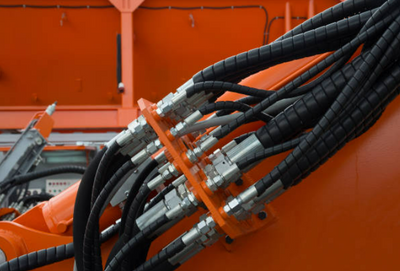
Hydraulic hose safety is not created by adding one sleeve to every line. The assembly has to be correct for the fluid and operating envelope, routed without harmful stress, protected from its actual surroundings, and inspected before damage reaches reinforcement or a coupling.
A useful review divides the installation into six zones. Each zone answers a different question and can require a different corrective action.
1. Confirm the assembly specification
Identify the hose family, size, pressure and temperature range, fluid compatibility, reinforcement, ends, and approved coupling system. Include possible transient pressure and the surrounding temperature, not only the normal gauge reading and oil temperature.
Hose, stem, ferrule, and crimp specification must form a qualified assembly. Mixing components because they fit the same crimper or look similar is not evidence of compatibility. Record the assembler, date, part identity, and any test or inspection required by the equipment program.
Age alone does not predict remaining life, and a published impulse-cycle value is not a field-life promise. Duty cycle, temperature, bend, contamination, storage, and installation can change service life substantially.
2. Review pressure and stored energy
Relief settings, load-induced pressure, valve transients, trapped volumes, and accumulators can expose a hose to different conditions. A machine may retain hydraulic energy after the engine is off. Before inspection that requires contact or disassembly, isolate the system, support loads, and relieve or restrain stored energy using the approved procedure.
Never use a hand to locate a pinhole leak. Escaping fluid can penetrate skin and requires immediate emergency medical treatment. Use a rated barrier or detection method defined by the equipment safety procedure.
Where people are within a potential spray path, evaluate guards or fluid-containment sleeving against the applicable machine standard and risk assessment. The protective product does not increase the hose pressure rating.
3. Follow the complete motion envelope
Observe where the hose moves as cylinders extend, steering articulates, a boom rotates, or an attachment changes position. Preserve minimum bend radius and prevent twist. The printed lay line can help reveal an assembly installed with rotation between its ends.
An assembly that is too short pulls on couplings and may bend immediately behind the ferrule. Excess length can form a loop that snags, rubs, or crosses a pinch point. A 45-degree or 90-degree fitting may improve routing only when its orientation matches the machine geometry and does not add a new restriction or bending load.
Clamps should control motion without crushing the cover. Allow required travel between fixed and moving points.
4. Map abrasion and impact contact
Look for polished cover, flattened areas, cuts, exposed wire, displaced guards, debris beneath clamps, and matching marks on nearby structure. Hoses can rub one another as pressure and movement change their position.
Textile wraps can separate bundled hoses; spiral guards can address localized rub and impact; spring guards can protect exposed lines while permitting flex. Choose a product whose material, fastening, movement, temperature, and inspection method suit the location.
Protection should not be used to preserve a bad route. Remove the sharp contact, add a smooth guide, or alter the controlled geometry when possible.
5. Separate heat, flame, and chemical hazards
Engine exhaust, hot process equipment, radiant heat, weld spatter, and fire exposure are different hazards. Verify the protective product’s tested continuous and intermittent limits for the exact construction. Do not transfer dramatic temperature claims from one fire sleeve to another.
Oil, fuel, deicing fluid, fertilizer, cleaning agents, salt, ultraviolet light, and ozone can affect hose covers and guards. Confirm compatibility with the hose and protection manufacturers. A sleeve that survives heat may retain a chemical against the cover or conceal a leak.
If a fluid leak could reach an ignition source, routing and shielding should control the spray path as well as the temperature at the hose surface.
6. Inspect the coupling transition
The area where flexible hose meets a rigid fitting often receives concentrated bend and vibration. Check for wetness, corrosion, cover separation, a shifted ferrule, damaged threads, loose adapters, and movement between components.
A bend restrictor can distribute flex away from the coupling for an assembly designed to use it. It should not be improvised to hide an assembly that is too short or incorrectly oriented. Spring guards and sleeves also need secure, non-damaging terminations.
If reinforcement is exposed, the cover is blistered or cracked, the hose is kinked, the coupling has moved, or leakage is present, follow the replacement criteria rather than postponing action with tape or an added wrap.
Turn observations into a maintenance record
Set inspection intervals from machine criticality, exposure, motion, prior failures, and manufacturer requirements. Record the exact location and defect, not only “hose checked.” Photographs and hose identifiers help track gradual change.
After replacement, verify routing through the safe motion cycle and inspect early enough to confirm that the original contact or heat path has been removed. If similar machines share the same design, check the population for the same condition.
These six zones keep hose safety tied to evidence. The correct assembly, controlled pressure, adequate motion, removed abrasion, managed environment, and stable coupling transition are more effective together than any universal sleeve or replacement interval.