
Do Not Confuse Push-In Tube Terminations with Quick-Disconnect Couplings
HGW Hydraulics on Jun 6th 2024
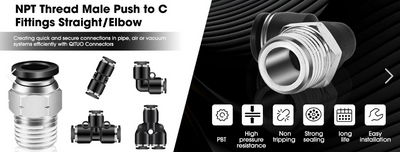
Catalogs apply several fast-connection labels to different mechanisms. A push-in fitting normally terminates tube with a collet or grab ring and O-ring. A quick-disconnect coupling joins a plug and socket so a circuit or tool can be separated as an operating or service function.
Calling both “fast” does not make them interchangeable.
Ask whether the tube or the circuit is being disconnected
A push-in fitting is installed by inserting prepared tube to a stop. Some designs permit release and remake, but repeated daily coupling is not automatically their intended duty.
A quick-disconnect has two mating coupling halves and a positive locking mechanism. It is chosen when an attachment, hose, test line or tool must be connected and removed as a pair.
The release sequence, cycle count and residual-pressure condition should be specified before choosing either product.
Separate grip parts from shutoff valves
In a push-in fitting, internal teeth or a collet retain tube and an O-ring seals its OD. These components are not poppet valves.
A quick coupling may contain a valve in neither half, one half or both halves. Valve arrangement affects fluid loss, air inclusion and behavior while disconnected. A dry-break or flat-face design adds other features that must be verified from product data.
Do not state that all quick couplings self-seal or that all push-in fittings prevent flow when released.
Compare restriction and pressure effects
Valves and small internal passages can create pressure drop and heat. Review flow data for the exact coupling series, fluid viscosity and size.
Push-in tube fittings also reduce effective bore at elbows or transitions. In pneumatic control, water or vehicle air, delivered flow and response can matter even at modest pressure.
Identify the ends outside the fast mechanism
A quick coupling body can terminate in NPT, ORB, hose, compression or another end. A push-in fitting may connect tube to a threaded port, another tube or a bulkhead.
Describe both the coupling interface and equipment-port end. A correct plug profile with the wrong pipe thread is still the wrong assembly.
Apply the service-specific approval
Regulated vehicle air-brake tubing requires fittings approved for that service. Hydraulic, breathing, medical, potable-water and chemical connections have their own material, cleanliness and safety requirements.
Brass, stainless and polymers each have valid uses, but material alone does not establish approval or pressure class.
Maintain the intended mechanism
For push-in tube, inspect cut quality, insertion marks, scratches and collet damage. For quick couplings, inspect locking features, faces, valve action, seals and contamination caps.
The reliable name follows the function: terminate tube or repeatedly separate a circuit. Once that is clear, pressure, media, valves, certification and end connections can be selected without relying on ambiguous catalog wording.