
Distinguish Code 61, Code 62, and OEM Four-Bolt Flange Patterns
HGW Hydraulics on Jan 25th 2022
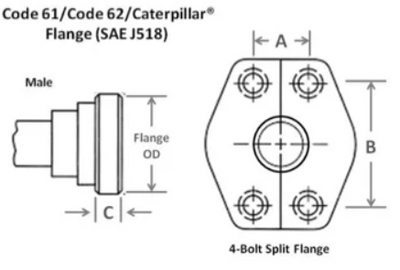
Code 61 and Code 62 are compact four-bolt hydraulic flange families used at pumps, motors, valves and large conductors. Both compress an O-ring between a flanged head and a flat port face, but their patterns and product ratings must not be blended.
OEM variants can look even closer, so identification requires more than counting four holes.
Let the standard and size define the series
SAE J518 and corresponding ISO 6162 parts define flange heads, ports, O-ring grooves, clamps and attaching hardware for their covered ranges. Code 61 is commonly called the standard-pressure series and Code 62 the higher-pressure series.
Those names are not universal pressure values. Allowable working pressure varies with standard part, nominal size, material and completed connection. Use the current table for the exact series and never convert a catalog maximum from one size into a promise for another.
Compare the pattern as a set
Measure port diameter, bolt spacing in both directions, flange-head outside diameter and thickness, groove and O-ring, clamp geometry and fastener details. Code 62 generally uses a larger pattern than Code 61 at a corresponding size, but visual scale is not a gauge.
A head that sits inside the clamp does not prove the groove or port face matches. Do not tighten bolts to draw a near-match into alignment.
Treat OEM patterns as separate candidates
Mobile equipment may use flange heads that resemble a standard series while changing head thickness, O-ring dimensions, pilot features or fasteners. Another OEM pattern may share much of a Code 61 layout but use a different seal.
Replace an OEM connection only after checking its drawing or dimensional reference. If a verified standard adapter is used, the standard O-ring, clamps and hardware must form one compatible connection; mixing the old seal with the new head is not an assumption to make.
Do not declare international interchangeability broadly
SAE, ISO, former DIN references and JIS flange systems may share dimensional ancestry. That does not mean every part is interchangeable except for bolt size. Editions, series, size availability, fastener threads, head dimensions and O-ring grooves can differ.
Document the exact standard and revision on each side of a proposed substitution. An absent size in one standard is a reason for special verification, not a reason to use the nearest pattern.
Assemble the verified connection evenly
Inspect the port face and groove for scratches, corrosion, paint and burrs. Install the specified O-ring clean and without twist. Align the conductor without using bolts to correct a routing error.
Use the correct clamps and fasteners, then follow the specified tightening sequence and torque method. After safe pressure restoration, inspect for leakage without approaching a potential high-pressure spray path.
The reliable distinction between Code 61, Code 62 and an OEM flange is dimensional and documented. A familiar four-bolt silhouette only begins the identification.