
Choose an Instrumentation Tube Fitting as a Complete Ferrule System
HGW Hydraulics on Jan 28th 2026
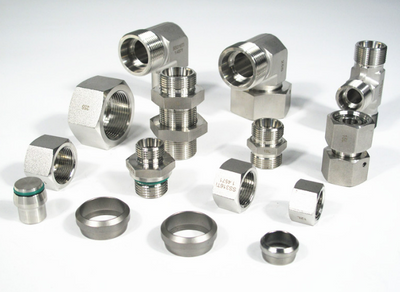
The number of ferrules does not by itself determine whether an instrumentation tube fitting is safe for a service. A single-ferrule and a two-ferrule design distribute sealing, tube grip, and nut load differently, but both depend on the manufacturer’s complete geometry, materials, heat treatment, tolerances, and assembly instructions.
Selection should begin with the tube and operating requirements, not with a claim that one architecture is universally better.
A compression assembly has interacting parts
A typical fitting includes a body, nut, one or more ferrules, and correctly specified tube. Tightening the nut drives the ferrule system into contact with the body and tube. The resulting deformation must create a seal while holding the tube against pressure, vibration, thermal cycling, and installation loads.
The thread on the nut provides assembly force; it is not normally the process-fluid seal. Surface condition, tube outside diameter, wall thickness, hardness, roundness, material compatibility, and tube preparation all influence the connection.
Components from different product families should not be mixed unless the manufacturers provide documented compatibility. Similar-looking nuts and ferrules may use different angles, gaps, or hardening profiles.
Single-ferrule designs combine sealing and grip
In a single-ferrule fitting, one component contacts the fitting body and tube to create the seal and retention. Reducing the part count can simplify handling, but the actual behavior depends on whether the ferrule is front-loaded, back-loaded, symmetrical, or another proprietary design.
Materials range from polymers and brass to steel and stainless steel. It is not reliable to say that single-ferrule fittings belong only with soft materials or that they always perform better under vibration. Qualification results for the exact fitting, tube, and service are stronger evidence than a broad design label.
Two-ferrule designs divide functions between front and back parts
A two-ferrule assembly commonly uses a front ferrule to form the primary seal at the body and a back ferrule to grip the tube and control load transmission. The arrangement can reduce the amount of nut torque transferred directly to the sealing contact and can provide controlled tube support.
That general description does not make every two-ferrule product equivalent. Ferrule orientation, material, hardness, tube bite, remake procedure, and inspection method are manufacturer-specific. Reversing the ferrules or substituting a visually similar back ferrule can prevent correct assembly.
Pressure and vibration are system qualifications
Allowable pressure depends on the fitting, tube material, outside diameter, wall thickness, temperature, fluid, assembly, and applicable code. A rigid stainless fitting may still be limited by thin-wall tubing. Conversely, choosing more ferrules does not upgrade an unqualified tube.
Vibration performance also depends on tube support and alignment. A sound fitting cannot compensate for an unsupported tube that repeatedly flexes at the nut. Clamp spacing, machine motion, pulsation, and resonance should be addressed in the installation design.
Use application evidence to choose
For a new system, document process fluid, pressure and temperature range, ambient exposure, tube specification, cleanliness, corrosion requirements, cyclic loading, inspection needs, and applicable code. Compare manufacturer test data and certifications for that complete configuration.
For maintenance, identify the installed fitting series before disturbing it. Record markings, tube dimensions, body connection, ferrule arrangement, and assembly condition. Follow the product’s remake or replacement instructions; do not apply a generic turn count to an already assembled connection.
Cut tube squarely, deburr without reducing wall thickness, remove deep scratches in the sealing zone by replacing the affected section, and insert the tube fully. Use the specified gap gauge, presetting tool, or inspection method when the system provides one.
Treat the fitting and tube as one controlled specification
Single- and two-ferrule fittings can both serve plumbing, analytical, hydraulic, gas, process, and instrumentation applications when qualified for them. The defensible selection is the design whose complete assembly meets the required service and can be installed and inspected consistently.
Counting ferrules is a useful identification step. It is not a substitute for matching the tube, pressure-temperature envelope, materials, manufacturer system, and documented assembly procedure.