
Prevent Stainless Thread Galling before Clamp Load Becomes Unstable
HGW Hydraulics on May 6th 2026
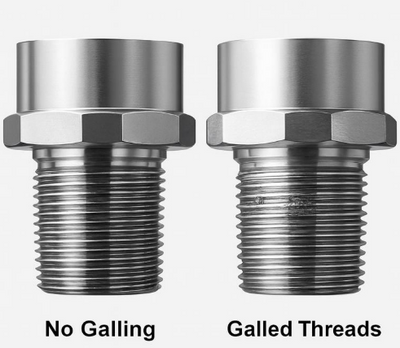
Galling is adhesive damage that begins when loaded thread asperities transfer material between mating surfaces. Continued rotation tears and raises the damaged areas until torque increases sharply or the joint seizes.
On a hydraulic fitting, that friction change can also make the intended clamp load uncertain before the parts lock.
Recognize conditions that raise risk
Austenitic stainless threads can be susceptible because of their ductility, work hardening and protective oxide behavior under sliding contact. Risk increases with similar stainless surfaces, rough or damaged threads, high contact pressure, poor lubrication and rapid assembly.
304 and 316 components can gall, but alloy label alone does not predict every joint. Thread quality, coatings, hardness difference and nut/body design matter.
Stop at abnormal resistance
Start threads by hand and verify alignment. A sudden rise in torque before the sealing surfaces reach their reference point can indicate cross-threading, contamination or the beginning of galling.
Do not use an impact tool or longer wrench to force the joint. Backing off after severe adhesion can tear both parts; follow the service procedure and replace damaged components.
Inspect for smeared metal, torn flanks, rough spots and elongated material transfer.
Choose lubricant for the whole system
A specified compatible lubricant or anti-seize can reduce friction and adhesion. It must also meet fluid, temperature, cleanliness, oxygen-service and process restrictions.
Lubrication changes torque-to-clamp behavior. Use tightening values for that condition rather than applying a dry table after anti-seize. Keep compound away from ORFS faces, O-rings and fluid passages unless the procedure requires it there.
Consider surface and material engineering
Where galling risk is persistent, the product design may use dissimilar hardness, coatings or treatments and suitable thread finish. Do not apply an unapproved coating that changes fit, corrosion behavior or cleanliness.
Protect stainless threads from grit and carbon-steel contamination during storage. Replace protective caps only when assembly is ready.
Preserve serviceability through procedure
Tighten at controlled speed with correct tools and backup wrench. For JIC, ORFS, ORB or other hydraulic forms, identify which seat or seal needs clamp load and follow its specified method.
Record lubricant and torque/flats condition for future remake. If a connection must be opened frequently, consider a verified swivel or coupling so stainless threads are not repeatedly cycled beyond their intended use.
Galling prevention is not merely applying anti-seize. It is controlling contact surfaces and friction so tightening remains a predictable assembly step.