
Use Stainless Hydraulic Fittings Where Corrosion Control Justifies Them
HGW Hydraulics on Oct 29th 2024
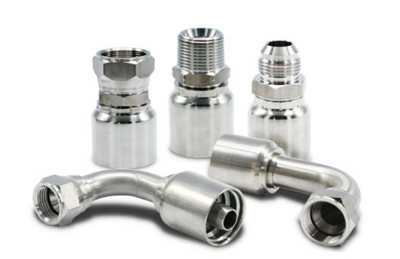
Stainless steel can solve a difficult hydraulic corrosion problem, but it cannot correct a mismatched thread, damaged seal or underrated assembly. The purchasing decision should begin with the connection and service conditions, then determine whether a stainless grade provides value over coated carbon steel or another approved material.
Map the connection before selecting the alloy
Straight adapters, elbows and tees manage routing. Bulkheads cross panels. Banjo shapes address compact geometry. Tube fittings, hose ends and port adapters create different conductor interfaces. Each body shape can be manufactured with several thread and seal families.
NPT and BSPT are tapered pipe threads. BSPP is parallel and generally uses a defined seat, washer or elastomer in hydraulic port service. JIC seals at a 37-degree flare, ORFS at a flat O-ring face and ORB at an O-ring boss port. Metric tube and port systems require their exact standard and form.
Stainless construction does not make these families interchangeable. Identify both halves and the seal location before choosing a grade or body style.
Decide whether the corrosion zone reaches the fitting
External salt, wash chemicals, fertilizer, process spray and trapped moisture can consume plating or damage sealing surfaces. Internally, the hydraulic fluid, additives, water content and contaminants contact the fitting and elastomer. Dissimilar-metal interfaces can introduce another local corrosion path.
Stainless may reduce coating loss and red rust in exposed zones. It is not corrosion proof. Grade, surface condition, temperature, chloride concentration, crevice geometry and cleaning determine whether the passive film remains effective.
Choose the stainless grade from evidence
304 can serve many general industrial environments. 316 and 316L normally improve resistance to certain chloride and chemical exposures, while the low-carbon L grade can matter when welding is involved. Other stabilized or higher-alloy grades address different temperature or corrosion cases.
Do not select an unfamiliar grade from a broad marketing statement. Require a material designation tied to a recognized specification and confirm that the fitting form, bar or forging route, seals and mating components are available in that material.
Rate the full pressure boundary
Pressure capability is specific to the product design, size, temperature and material condition. Hoses, tubes, ports, O-rings, bolts and adapters form a chain; the lowest qualified limit controls the assembly. A burst-to-working-pressure ratio should come from the applicable standard or manufacturer data, not a universal multiplier added to every part.
Dynamic circuits also need attention to impulse, vibration, support and bending load. Corrosion resistance cannot compensate for a hose pulling sideways on an adapter or a tube forced into alignment.
Preserve the sealing surface during installation
Stainless threads can gall. Use the specified lubricant or anti-galling practice only when it is compatible with the fluid, elastomer and cleanliness class. Control alignment and tightening by the connection procedure rather than adding wrench force until leakage stops.
Keep tape away from JIC, ORFS and ORB sealing surfaces. Inspect flare cones, face-seal grooves, port spotfaces and O-rings before assembly. A scratched stainless seat remains a scratched seat.
Apply stainless selectively across real equipment
Marine decks, outdoor washdown equipment, chemical skids and some food or pharmaceutical utilities may justify stainless. Mobile machinery may use it at salt-exposed or chemical-contact locations while retaining coated steel inside protected compartments. Robotics and renewable-energy equipment can use the same zone-based reasoning when access or weather exposure raises replacement cost.
Regulated sanitary or high-purity service requires more than alloy: surface finish, cleanability, documentation, elastomer, fabrication and listing requirements still apply.
Compare total cost without inventing a lifetime
The stainless option may cost more to machine and purchase. Its business case can include avoided coating repair, fewer corrosion-driven replacements, easier cleanup and reduced exposure to unplanned access work. Those benefits depend on the actual environment and maintenance history.
Estimate cost by location rather than assigning one return-on-investment percentage to an entire plant. Include the fitting, compatible mating parts, installation labor, flushing, equipment access and consequence of leakage. A protected indoor connection may show no benefit from stainless, while a remote salt-exposed joint may justify it quickly.
Stainless is widely recyclable, but a sustainability claim should account for alloy recovery, local recycling route, manufacturing and service life. Recyclability does not establish hydraulic suitability.
Plan inspection around stainless-specific risks
Check exposed fittings for deposits, crevice attack and contact with dissimilar metals. Look for galling or torn threads after disassembly and replace damaged sealing surfaces instead of polishing them casually. In welded or fabricated sections, verify heat-tint removal and surface restoration if the governing procedure requires it.
Retain material and seal records where a chemical or regulated process depends on traceability. A corrosion incident should trigger review of grade, cleaning chemistry, stagnant zones and neighboring materials, not an unsupported assumption that the delivered part was not stainless.
Make the purchase description auditable
Record the connection standard and form, size, body shape, exact stainless designation, pressure and temperature basis, fluid, seal compound, surface requirements and documentation. Confirm wrench clearance and whether an adjustable orientation is needed.
This specification shows why stainless was chosen and where it is necessary. It also prevents an expensive alloy upgrade from concealing the real cause of a recurring leak.