
Stainless Hydraulic Hose Ends: Corrosion Benefits and Assembly Limits
HGW Hydraulics on Feb 19th 2025
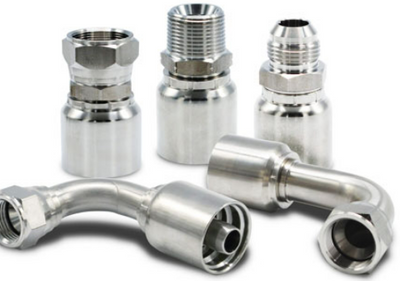
Stainless steel hose ends are useful where carbon-steel fittings would corrode from the conveyed fluid, washdown, chemicals, salt, humidity, or outdoor exposure. Their corrosion resistance can reduce coating loss and rust contamination, but it does not make the hose assembly unlimited in pressure, temperature, or service life.
The fitting must belong to a matched assembly: exact hose construction, stem, ferrule, preparation, crimp diameter, external connection, and inspection procedure.
Alloy selection begins at both surfaces
304 stainless provides broad general corrosion resistance. 316 adds molybdenum and can improve resistance to pitting in many chloride environments. Neither is immune to hot chlorides, seawater crevices, acids, cleaning chemicals, or galvanic contact.
Internal fluid and external atmosphere may point to different risks. Hydraulic oil can be compatible while road salt attacks the ferrule. A washdown chemical can affect the O-ring or hose cover before the stainless body.
Specify exact grade and material standard rather than “stainless.” Control carbon-steel contamination during manufacturing and storage, and use cleaning or passivation processes appropriate to the component.
The hose often sets the temperature boundary
Metal properties at elevated temperature do not define the allowable assembly temperature. The inner tube, cover, reinforcement adhesion, O-rings, and crimp interface can have lower limits. Heat also accelerates aging and changes pressure capability.
Fire sleeves and heat guards have their own continuous and short-duration exposure ratings; they do not raise the hose’s fluid-temperature rating. Route away from heat and use shielding validated for the hazard.
Use the hose manufacturer’s combined pressure-temperature and media data for the exact product.
Pressure belongs to the tested assembly
A stainless adapter rating cannot be assigned to a crimped hose end of similar size. Hose series, wire or textile reinforcement, stem serration, ferrule, crimp setting, end shape, and dash size all influence performance.
Follow the approved crimp specification and verify crimp diameter at the defined location. Skiving or no-skive preparation must match the hose and fitting system. Mixing a stainless stem from one series with a convenient ferrule from another is not validated by physical fit.
Impulse, vibration, bend, and pull loads also affect service. Support the route so the hose does not flex at the stem.
External connection still needs full identification
Stainless hose ends can terminate in JIC, ORFS, NPSM, NPT, BSP, metric, flange, quick-coupler, or other designs. Confirm size, thread, seat, gender, seal, orientation, and mating port.
Material upgrading cannot fix a 30-versus-37-degree flare mismatch, a BSP-to-NPT false fit, or a damaged ORFS face. Stainless threads can gall, so use the specified lubricant or sealant and tightening method without contaminating the circuit.
Applications impose different cleanliness and documentation
Marine, oil and gas, construction, locomotive, metal-processing, food-equipment, pharmaceutical, and hose-fabrication work can all use stainless assemblies. Each has different media, codes, cleanability, abrasion, traceability, and maintenance needs.
A food or pharmaceutical process may require hygienic design not provided by an ordinary hydraulic hose end. Sour oil and gas service can require project-specific material qualification. Construction equipment may need abrasion guards and routing improvements more than a higher alloy.
Inspect the whole end during service
Look for corrosion, cracked or displaced ferrules, wetness, hose pullout, cover damage, hardening, blistering, exposed reinforcement, loose supports, and seal-face damage. Do not judge remaining life from stainless appearance alone; the hose can age while the fitting still looks new.
Replace assemblies under the equipment and hose manufacturer’s criteria. Record hose series, ID, length, both end configurations, orientation, fitting alloy, crimp data, fluid, and location. Pressure-test and clean to the specified procedure.
Stainless hose fittings add value when corrosion is the identified threat and the complete hose assembly remains controlled. Their strength is preserving a compatible connection in a harsh environment—not replacing the need to specify, crimp, route, and inspect the hose correctly.