
Design Stainless Saltwater Fittings against Pitting and Crevice Attack
HGW Hydraulics on Jul 10th 2024
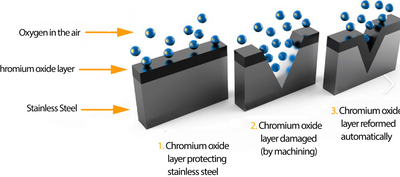
Saltwater is not a mild environment for stainless steel. Chlorides can break down a passive surface locally and produce pitting or crevice attack even when most of the part remains bright.
Stainless often outperforms unprotected carbon steel, but grade, geometry and maintenance determine whether that advantage is adequate.
Understand what the passive film can and cannot do
Chromium in stainless steel supports formation of a thin protective oxide in an oxygen-containing environment. If a clean surface is scratched and conditions permit, the film can reform.
Deposits, gasket crevices, stagnant water and tight threaded spaces can restrict oxygen and concentrate chlorides. Those locations may corrode while an exposed face looks unaffected.
The claim that salt has minimal impact should therefore be rejected. Exposure concentration, temperature, flow, wet-dry cycling and contamination all matter.
Select an exact grade
316/316L commonly offers better chloride pitting resistance than 304/304L because of molybdenum, but it is not seawater-proof. More demanding temperature, concentration or crevice conditions may require duplex or higher-alloy materials after engineering review.
Strength, weld condition, product form and fitting availability also affect the decision. Do not substitute an alloy family without checking the connection rating and fabrication specification.
Use cleaning and passivation correctly
Fabrication can embed free iron or leave heat tint and contamination that weaken local corrosion resistance. Cleaning, pickling or passivation may be specified to remove contamination and support a chemically clean surface.
ASTM A967/A967M covers defined chemical passivation treatments and verification options for stainless parts. Passivation is not a coating that makes the wrong grade immune to chlorides, and it does not remove heavy scale without appropriate preparation.
Keep carbon-steel tools, grinding dust and storage surfaces from contaminating finished stainless components.
Control geometry and mixed metals
Provide drainage and access for rinsing where salt deposits can accumulate. Avoid dead legs and shielded crevices when design permits. Gaskets and seal grooves should be selected with inspection and crevice conditions in mind.
Galvanic contact with carbon steel, aluminum, brass or other metals can accelerate attack depending on electrolyte and area ratio. Isolation, coatings or compatible materials must be engineered as part of the joint.
Inspect the complete fitting
Check threads, seats, welds, clamps and fasteners as well as the body. An appropriate stainless fitting still needs a compatible O-ring, hose or tube and product pressure rating.
Trend tea staining, deposits, pits and crevice corrosion at clamps or seals. Replace based on applicable criteria before loss of section affects the pressure boundary.
Stainless is valuable in coastal and marine systems because its passive behavior can be designed and maintained. It should be selected with chloride failure mechanisms in view, not sold as corrosion proof.