
Brass or Stainless Fittings: Select by Fluid, Environment, Load, and Connection
HGW Hydraulics on Jul 18th 2024
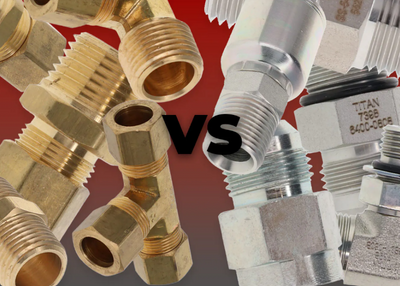
Brass and stainless steel can both resist the red rust associated with unprotected carbon steel, but they do so through different alloy systems. Brass is copper-zinc based; stainless relies on a chromium-rich passive film. Neither material is one fixed composition, and neither is correct for every fluid connection.
Selection begins with the exact alloy and product standard, then considers media, external exposure, load, temperature, connection geometry, and the consequence of leakage.
Alloy family matters more than color
Brass grades vary in copper and zinc content and may include lead, tin, silicon, or other additions for machinability, strength, or corrosion behavior. Requirements for potable water, food contact, or lead content can restrict acceptable grades.
300-series stainless fittings commonly use 304 or 316 families. Chromium supports passivation; nickel stabilizes the austenitic structure; molybdenum in 316 improves resistance to localized attack in many chloride environments. Exact composition and properties come from the applicable material specification.
Visual inspection cannot confirm alloy. Plating, polishing, and service discoloration can make different materials look similar.
Corrosion mechanisms separate the choices
Brass does not form iron rust, but certain waters, chemicals, temperatures, and flow conditions can cause dezincification, stress-corrosion cracking, erosion-corrosion, or general attack. A dezincification-resistant grade may be required; ordinary brass should not be assumed resistant because the environment is wet.
Stainless can pit or develop crevice corrosion in chlorides and can suffer stress-corrosion cracking under particular combinations of tensile stress, temperature, and chemistry. Deposits and stagnant crevices can prevent the passive film from recovering.
For either material, compare reliable compatibility data with actual concentration and temperature. External cleaners, road salt, seawater spray, and dissimilar-metal contact matter along with internal fluid.
Mechanical requirements belong to the finished component
Stainless alloys often provide higher strength than common fitting brasses, but an alloy strength value is not a fitting pressure rating. A cast elbow, forged adapter, compression body, valve, and hose barb respond differently. Thread form, wall thickness, size, manufacturing route, seal, and temperature control the complete product.
Brass can offer useful ductility, machinability, and thermal or electrical conductivity. It appears in instrumentation, pneumatic, water, refrigeration, and suitable lower- or moderate-demand fluid systems. Stainless supports demanding corrosive process, hydraulic, marine, and washdown use when the grade is compatible.
Do not replace brass with stainless in an approved system without checking galvanic effects, sealing load, thread galling, component ratings, and code requirements.
Assembly behavior is different
Brass is softer and can be damaged by excessive wrench load, distorted seats, or cross-threading. Stainless threads can gall and seize under high contact stress, especially when dry or misaligned. Follow the fitting manufacturer’s lubrication, sealant, and tightening instructions for the exact connection.
The seal may be a JIC flare, ORFS face O-ring, ORB port O-ring, NPT or BSPT thread, BSPP washer, compression ferrule, or another interface. Material does not change where that connection is intended to seal.
Mixed brass and stainless parts can create galvanic corrosion when they are electrically connected in a conductive environment. Area ratio, electrolyte, potential difference, coating, and drainage determine risk. An isolating strategy requires engineering review, not merely a tape wrap.
Cost should include replacement conditions
Brass often costs less to machine and purchase for suitable applications. Stainless may reduce corrosion-related replacement in a compatible aggressive environment, but material price, machining, availability, alloy markets, and quantity vary.
Total cost includes downtime, inspection, contamination, adapter changes, and the ability to source the exact connection. Paying more for stainless does not solve a misidentified thread or an incompatible O-ring.
Document the decision for future service
Record alloy grade, material standard, connection and size, body configuration, media, temperature, working conditions, external environment, seal, and required documentation. Keep brass and stainless look-alikes separated and protect machined sealing faces.
For an installed replacement, identify the original failure mechanism. If brass dezincified, a resistant brass or another alloy may be appropriate. If stainless pitted under chlorides, moving to 316 may or may not be sufficient. If the leak came from a damaged seat, changing alloy misses the cause.
Brass and stainless are both valuable fitting materials. The defensible choice is the one whose exact alloy and component design address the known corrosion, mechanical, and connection requirements—not the one with the stronger general reputation.