
Select Hose-End Steel by Crimp Formability and Corrosion Exposure
HGW Hydraulics on Sep 11th 2024
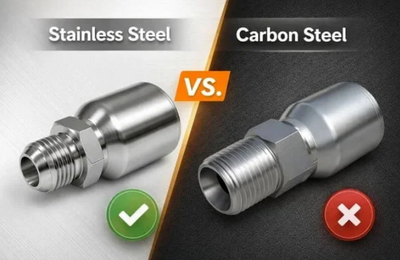
Hose-end material has to survive two different jobs: controlled deformation or retention during assembly and long-term exposure on the machine. Carbon steel and stainless steel can both support hydraulic hose ends when the exact stem, ferrule, hose, crimp, environment, and connection are qualified.
Evaluate the stem and ferrule as manufactured parts
Steel chemistry, heat treatment, forming, machining, brazing or welding, and surface condition affect a hose fitting. A harder alloy is not automatically better. Ferrules and stems must deform or carry load as intended without brittle cracking, excessive springback, or loss of grip.
Avoid broad claims that “high-carbon steel” is always unsuitable or that one generic mild steel is the correct answer. Use the material and process specified by the hose-fitting manufacturer. Do not substitute ferrule material from appearance.
Qualify the complete crimp system
Confirm hose family and dash size, stem, ferrule, insertion depth, skive requirement, die, crimp diameter, tooling, orientation, and inspection. One-piece and two-piece architectures have product-specific data.
The finished assembly is limited by the hose, ends, seal, and connection rating. A stainless stem does not upgrade an unqualified hose, and a coated steel ferrule does not establish pressure through material strength alone. Keep crimp records and traceability required by the assembly program.
Map corrosion inside and outside the end
Coated carbon steel can offer cost-effective service in protected and many mobile hydraulic environments. Zinc, zinc-nickel, phosphate, paint, or another specified finish protects external surfaces. Crimping, wrenching, rubbing, salt, moisture, fertilizer, and washdown can damage that protection.
Stainless can provide a major advantage in marine, chemical, food-processing, and high-moisture zones. Select exact grade. 316 often improves pitting resistance in many chlorides but can still corrode in crevices or under deposits. Stainless threads can gall, and a stainless fitting may contact a different metal or an incompatible O-ring.
Inspect corrosion at the hose-end interface, hex, threads, flare face, O-ring groove, and ferrule edges. Internal media compatibility can differ from the exterior environment.
Reject unsupported weight and temperature shortcuts
Stainless hose ends do not universally use thinner walls or weigh less than carbon-steel versions. Geometry and rating must be compared from the actual drawings or catalog data. Stainless also does not have one broader temperature range; hose tube, cover, seals, ferrule, connection, and qualification can control first.
Sanitary or food use requires cleanability, surface, elastomer, process approval, and documentation beyond a stainless label. Carbon steel is not automatically prohibited from every food facility, though it may be unsuitable for wetted or washdown zones under the applicable design.
Calculate material value at the exposure point
Compare fitting price, assembly labor, stock, lead time, inspection, corrosion replacement, downtime, and consequences of leakage. Recycling value should not be presented as a guaranteed profit. Stainless may justify higher cost at exposed ends, while coated steel remains effective inside protected compartments.
Use a zone strategy and field evidence rather than one material across the fleet. The purchase description should include hose and fitting system, material or coating, equipment-side connection, seal compound, pressure and temperature, media, environment, and required documentation. That makes material choice part of a qualified hose assembly rather than an isolated alloy preference.