
Control Static Charge Across the Entire Industrial Hose Transfer Path
Sep 7th 2022
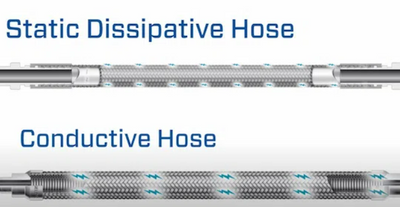
Static control in a hose operation cannot be assigned to the hose alone. Charge can develop during fluid transfer and then accumulate on hose reinforcement, couplings, containers, vehicles, or isolated equipment. The hazard becomes serious when a discharge can occur in an atmosphere containing flammable vapor, gas, mist, or combustible dust.
A facility should evaluate the entire transfer path under its hazard assessment and applicable codes. A conductive-looking component or a wire inside the hose is not proof that there is a reliable path to ground.
Identify where charge can be generated and retained
Movement and separation of unlike materials can transfer electrical charge. In hose systems, the fluid, suspended particles, hose tube, filters, splashing, high velocity, and turbulent restrictions can all influence charging. Low-conductivity liquids may allow charge to persist, and dry conditions can reduce natural dissipation from external surfaces.
Start with the product being transferred, conductivity data, flow conditions, temperature, loading method, and the possible presence of an ignitable atmosphere. Agricultural seed, powder, solvent, fuel, oil, chemical, vacuum, and pneumatic service do not present one identical static problem. A process-safety or fire-protection specialist should define controls where ignition consequences are significant.
Separate conductive hose from a verified electrical path
Static-dissipative or electrically conductive hose may use conductive compounds, a helix, or other engineered elements. The product data should state how the assembly is intended to dissipate charge and how continuity is established through the end fittings.
Cutting the hose, crimping the wrong coupling, failing to expose the conductive element, painting contact surfaces, or installing an insulating gasket can interrupt the path. Continuity should be tested using the hose manufacturer’s method and the facility’s acceptance limits. A generic resistance number should not be invented for an assembly without its governing specification.
Bonding connects conductive objects so a dangerous voltage difference is less likely to develop between them. Grounding connects the bonded system to earth. These functions are related but not interchangeable. Clamps need clean, suitable contact points, and cables must be protected from corrosion and mechanical damage.
Control the operation as well as the components
Flow velocity, splash filling, filters, agitation, and the sequence used to connect containers can affect charging. Follow the process design for loading rate, fill pipe position, bonding order, ventilation, and ignition-source control. Never rely on a worker feeling a shock as a monitoring method.
Where the risk assessment requires it, instruments and interlocks can confirm bonding or monitor conditions before transfer begins. Equipment must be appropriate for the classified or hazardous location. Employee training should cover the actual process, including what stops the transfer and who is authorized to restart it.
Inspect continuity after real service damage
Routine hose inspection still includes abrasion, soft spots, exposed reinforcement, kinks, blistering, leakage, loose couplings, and movement near the ends. Static-control inspection adds damaged grounding hardware, contaminated bonding points, broken conductive elements, altered routing, and unapproved repairs.
Test after a new assembly is built, after repairs, and at intervals set by the facility and component guidance. Record hose identity, date, method, result, tester, and disposition. A visual inspection cannot confirm hidden electrical continuity, while an electrical test cannot prove that the hose remains mechanically safe.
Use the failure scenario to choose the safeguards
A small nuisance shock, damage to sensitive electronics, and ignition of a vapor cloud have very different consequences. The selected safeguards should match the credible scenario and include hose construction, fittings, bonding, grounding, process controls, ventilation, housekeeping, inspection, and emergency response.
For purchasing, provide the fluid or material, conductivity information when available, pressure or vacuum, temperature, size, flow conditions, movement, connection ends, environment, and required electrical performance. That specification lets the supplier identify an assembly intended for the service without making the unsafe assumption that every rubber hose, metal fitting, or wire-reinforced product controls static in the same way.