
A Temporary Thread Seal Does Not Prove Hydraulic Compatibility
HGW Hydraulics on May 21st 2026
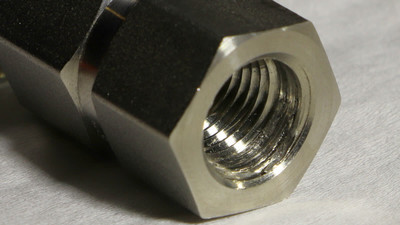
Two hydraulic parts can turn together and even remain dry during a short test while still being incompatible. Sealant, soft-metal deformation or contact at only a few flanks may delay leakage. Compatibility requires the same specified thread and sealing geometry, not temporary pressure retention.
Measure more than the included angle
Unified and metric fastener-style threads commonly use a 60-degree included form. NPT also uses a 60-degree profile, while BSP pipe forms commonly use 55 degrees. That distinction matters, but angle alone cannot identify a connection.
Record major diameter, pitch, taper or parallel condition, male and female form and engagement. Then inspect for a flare, cone, face, washer, O-ring or ferrule that actually seals the fluid. A correct thread paired with the wrong seat is still a mismatch.
Near matches create misleading feedback
Some NPT and BSP sizes have diameters and pitches close enough for partial engagement. Metric and unified straight threads can also be confused where measurements are taken roughly. A worn port may accept even more of the wrong part.
Lubricant reduces resistance, and sealant can fill a small gap. The installer may feel a normal wrench load while contact is concentrated at thread tips or one side of the port. This is distortion, not proof of designed engagement.
Cycling exposes the unequal load path
Pressure pulsation, vibration and temperature change repeatedly load the small contact area. Threads can fret, strip or crack; a soft female port may expand. The connection may also misalign the hose or tube and transfer bending into another seal.
When leakage begins, additional torque increases damage. Pressurized fluid can escape as a fine hazardous jet even if the original seep appeared minor.
Identify before using the wrench
Clean and examine the component safely. Use a pitch gauge, thread-profile gauge, caliper and seat-angle tool where applicable, then compare the results with controlled tables or drawings. Gauges and inspection tools should be maintained and suitable for the required decision.
Photograph the port, record the equipment and preserve known-good samples with labels. Training should include common regional pairs such as NPT/BSPT, BSPP/metric and 37-/45-degree flares, while emphasizing that visual comparison is only screening.
Remove damaged mismatches from the system
If a wrong part was tightened, inspect both male and female components. Replacing only the obvious adapter may leave a distorted port that damages the correct replacement. High-pressure or safety-critical ports should not be casually retapped or rethreaded in the field.
Use an approved repair, port replacement or engineered adapter under the equipment procedure. Thread sealant is not a temporary authorization for an incompatible pair.
A leak-free moment is only an observation. Standard identity, undamaged geometry and the correct mating seal are the evidence that a hydraulic connection belongs together.