
Use the Damage Pattern to Separate Heat, Abrasion, and Bend Failure in Hydraulic Hose
HGW Hydraulics on Jun 4th 2026
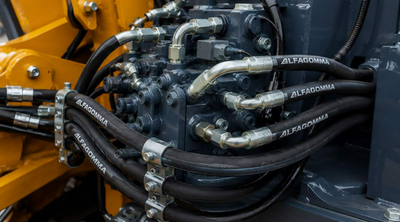
Heat, abrasion, and an over-tight bend can all end in a leak, but they leave different evidence and require different repairs. Replacing the hose without reading that pattern can put an identical assembly back into the same damaging location.
Before removing a failed line, photograph the route and mark the hose orientation when safe. Record the machine function, oil and ambient temperature, recent work, operating event, and exact location of the first visible damage.
Heat affects the tube, cover, reinforcement, and seals
A hose can be heated externally by an engine, exhaust, furnace, hot process, or radiant source. It can also be exposed internally to oil above its qualified range because of throttling losses, cooling problems, low reservoir level, or excessive duty.
Heat can harden, crack, soften, blister, or discolor elastomeric material depending on construction and exposure. It can accelerate oxidation and reduce flexibility near a fitting. The phrase “the liner melted” is not a universal failure description; material behavior must be evaluated against the actual hose and fluid.
Measure temperatures at the relevant operating condition. Restore cooling or routing, add a qualified shield when needed, and choose a hose whose pressure rating remains adequate at that temperature. A fire sleeve is not a substitute for correcting continuous overheating.
Abrasion reveals relative movement
Polished cover, parallel rub marks, exposed wire, or debris beneath a clamp show that the hose moved against another surface. Pressure cycles can slightly change length and diameter, while machine articulation moves entire bundles.
Find the matching contact on a bracket, edge, adjacent hose, guard, or structure. Reroute or add a smooth support before selecting a wrap, spiral guard, or sleeve. Protection should be compatible with the environment and should allow inspection.
Once reinforcement is exposed or damaged, follow the replacement criteria. Tape does not restore pressure capability or protect corroded wire.
Bend damage concentrates at geometry changes
Every hose has a manufacturer-specified minimum bend radius for its construction and size. Bending more tightly can distort reinforcement, flatten the flow passage, and concentrate stress. Repeated flex is especially harmful when it begins immediately behind a rigid coupling.
A fitting angle that appears convenient can still leave the assembly twisted or too short. Conversely, adding length can create a loop that rubs or snags. Check end orientation, tangent length near the coupling, support position, and the full machine motion.
Internal erosion is influenced by velocity, contamination, flow direction, and local geometry. It should not be attributed to every bend failure without inspecting the tube and operating condition.
Use a cause-and-correction check
For heat damage, verify fluid and external temperatures, hose derating, routing, and shielding. For abrasion, identify the moving contact and control it. For bend damage, compare actual radius and motion with the hose specification and assembly geometry.
Also confirm pressure transients, fluid compatibility, hose/coupling qualification, crimp data, contamination, and age. Multiple mechanisms can act together: heat can harden a cover that then cracks at an over-bent, rubbing location.
Validate the replacement in motion
Install the approved assembly without twist, support it without crushing, and preserve clearance from heat and edges. With the machine safely controlled, inspect it through the permitted motion range. Then check early in service for renewed contact, movement at the coupling, leakage, or temperature evidence.
Hydraulic hose failures become preventable when the damage pattern is connected to a physical cause. Heat requires an operating-envelope correction, abrasion requires control of relative motion, and bend failure requires corrected geometry. A replacement is complete only when that cause has been removed.