
A Torque Value Is Valid Only for the Specified Hydraulic Joint Condition
HGW Hydraulics on May 12th 2026
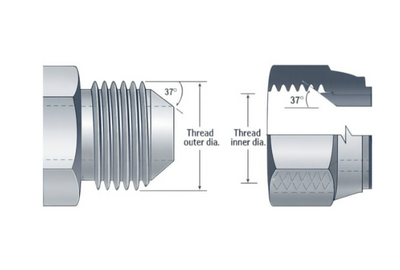
A torque wrench measures applied turning moment. It does not directly measure seal compression, thread preload, flare contact, O-ring squeeze, or remaining strength in a port. The same torque can create different joint conditions when friction, coating, lubrication, material, or assembly history changes.
This does not make torque charts useless. It means every value belongs to a defined connection and condition. Before using a number, identify what the joint is designed to seal and which variables the specification assumes.
Start with the sealing mechanism
JIC connections seal at a 37-degree flare, ORFS at a flat face and O-ring, and SAE O-ring boss at an O-ring against a port. Tapered pipe threads rely on thread interference with the specified sealant practice. Flareless and instrumentation fittings use ferrules or sleeves with their own assembly procedure.
The purpose of tightening differs among these designs. A flare nut brings two seats into controlled contact. An ORB adjustable elbow may require orientation, backup washer position, and locknut torque. A pipe connection advances into a taper. A ferrule fitting may be specified by turns from finger-tight rather than a simple torque value.
Using a generic fastener chart based only on thread diameter can damage the seal or port even if the wrench reading is repeatable.
Most applied torque is spent overcoming friction
In threaded fastener research, friction at threads and bearing surfaces consumes much of the applied torque, leaving only a portion to create useful preload. NASA torque-tension studies demonstrate that lubrication and repeated tightening can substantially alter the preload produced by the same nominal torque.
Hydraulic fittings are not all conventional bolted joints, but the friction lesson still matters: a torque value derived for a dry plated connection should not be transferred automatically to an oiled stainless connection.
Surface roughness, oxide, contamination, thread damage, coating thickness, and galling can all change the turning resistance. High torque caused by friction may coexist with insufficient seat contact, while reduced friction can overload a joint before the wrench reaches a dry value.
Lubricant and sealant must be part of the specification
Assembly oil, anti-seize compound, thread sealant, anaerobic adhesive, and residual hydraulic fluid are not equivalent. Each can alter friction, chemical compatibility, contamination control, cure, disassembly, and sometimes electrical or temperature behavior.
Apply only the product and quantity identified by the fitting, equipment, or engineering procedure. Keep lubricant off sealing faces or O-rings when the instructions require it. Do not add anti-seize to reach a torque smoothly unless the torque value has been established for that condition.
For tapered pipe threads, sealant selection and engagement affect sealing. Additional torque is not a reliable cure for a damaged or mismatched thread.
Plating and coating change more than corrosion appearance
Zinc, zinc-nickel, nickel, conversion layers, polymer topcoats, and other finishes have different thickness, hardness, and friction behavior. A coating can also be damaged by reuse or tool contact. Stainless threads rely on their material surface and can be prone to adhesive wear.
There is no safe universal rule that zinc always raises friction or that a smooth coating always lowers it. Coating systems can include friction modifiers, and production variation matters. Use a torque value tied to the actual part finish and mating material.
If a replacement part changes plating, base material, or supplier, review the assembly instruction rather than treating it as a cosmetic substitution.
Tool selection and technique add measurement variation
Use a calibrated torque wrench in the portion of its range recommended by its manufacturer. Confirm units before use; confusing pound-feet, pound-inches, and newton-meters can destroy a fitting. Apply force smoothly at the intended handle location and avoid a sudden jerk past the set point.
Extensions, crowfoot adapters, and off-axis loading can change effective torque. Apply the correct correction when the adapter changes lever length. Hold the mating body with a backup wrench where required so torque does not travel into a tube, hose, valve, or manifold.
Marking a completed joint can provide assembly evidence, but the mark does not prove the correct value was used or that the seal remained sound.
Material pairs need their own limits
Steel into steel, stainless into stainless, brass into steel, and steel into aluminum have different strength, friction, galling, and thread-stripping behavior. The weaker internal thread may control the joint. Temperature cycling and vibration can change load after installation.
Do not assume that a higher-strength fitting permits more torque when it is installed in a softer port. Inspect the port, spotface, chamfer, seat, O-ring groove, and thread engagement before assembly.
Stainless threaded parts should be turned slowly and aligned carefully to reduce galling risk. If resistance rises suddenly before expected engagement, stop rather than forcing the wrench to the chart number.
Tube nuts and port adapters also carry installation loads
Tightening a flare or face-seal nut while the tube is misaligned can draw the tube into position and leave a sustained side load after the wrench is removed. The connection may pass an initial leak check yet loosen, crack, or fret during vibration. Align and support the tube or hose before final tightening.
For straight-thread ports with elastomeric seals, inspect the spotface, chamfer, backup washer, and O-ring. The thread advances or locks the fitting, while the seal geometry controls fluid retention. More torque cannot restore a cut O-ring or damaged spotface.
Swivel nuts, bulkhead locknuts, flange bolts, and adjustable elbows each have different torque targets and backup-wrench requirements. Label the exact operation in the work instruction so an assembler does not apply a body torque to a swivel or use the hose as a reaction arm.
Sequence matters on multi-fastener joints
Four-bolt split flanges, covers, and manifolds need a controlled tightening sequence to distribute load. Bringing one fastener directly to final torque can cock a flange, pinch an O-ring, or create uneven preload. Use the specified staged and cross-pattern process with the correct components and gap criteria.
Where a procedure calls for multiple passes, record completion of the sequence rather than only the final wrench setting. Do not invent a retorque interval; some joints require one, while others can be damaged by disturbing a settled seal.
Temperature must be within the assembly procedure’s range. Tightening a hot joint can produce a different condition after cooling, and servicing a hot hydraulic connection adds burn and stored-pressure hazards.
Direct preload or elongation methods serve different joints
For critical conventional fasteners, engineering may use bolt elongation, tensioning, load-indicating hardware, or torque-angle methods to reduce uncertainty. Those methods require compatible joint design and calibrated procedures. They are not automatically applicable to a hydraulic tube nut or tapered pipe fitting.
The correct response to torque uncertainty is to select a verified assembly method for the joint—not to add an unrelated precision technique after the fact.
Reuse changes the condition represented by the chart
A torque value may be qualified for new components, a limited number of remakes, or a particular seal replacement. Prior tightening can burnish threads, remove coating, deform a flare, compress a ferrule, or damage an O-ring.
Inspect reusable surfaces according to the component instructions. Replace cut, flattened, hardened, swollen, or extruded seals. A pipe thread coated with old cured sealant needs an approved cleaning and inspection process; adding new sealant over debris does not restore the original condition.
Do not “check” an installed joint by turning it until the wrench clicks unless the procedure explicitly calls for that method. The extra movement may alter alignment or preload.
Build a controlled torque record
For critical or repeated assemblies, record part number and revision, connection type and size, material and finish, seal or lubricant, new/remake condition, torque value and units, tool identification and calibration status, operator, and date.
If field leakage appears, preserve the joint condition before tightening it further. Determine whether the cause is identification, surface damage, seal condition, alignment, contamination, assembly, port geometry, or operating load. Increasing torque without diagnosis can erase evidence and damage recoverable parts.
When a published chart conflicts with the component drawing or manufacturer instruction, the controlled instruction for the actual joint governs. Engineering should resolve gaps rather than averaging two numbers.
A torque value becomes reliable when its assumptions travel with it. Connection design, friction condition, finish, material, lubrication, tool method, and assembly history all define what the wrench reading means. Keeping that context prevents a precise tool from applying the wrong instruction accurately.