
Verify a Hydraulic Flange from Port Geometry to Bolt Load
Nov 30th 2022
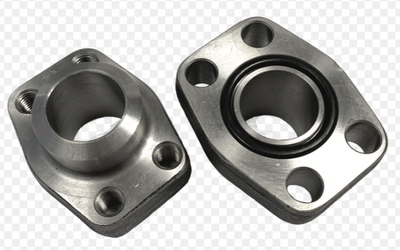
A hydraulic flange is a connection system, not just the metal head at the end of a hose. The port, flange head, O-ring, clamp halves or captive flange, bolts, washers, and mating tube or hose all have to match. Its advantage is a compact, serviceable connection for larger or highly loaded hydraulic lines, but only when the interface is correctly identified and assembled.
Start at the machine port
Flanges commonly connect hoses or tubes to pumps, motors, cylinders, valves, manifolds, and transmission components on mobile and industrial equipment. The machine drawing or manufacturer’s parts information is the preferred identification source.
When records are unavailable, measure the port and removed part after safe isolation. Record bolt spacing, bolt size, flange-head diameter and thickness, port bore, sealing-face geometry, O-ring groove or recess, and available clearance. Equipment brand can narrow the search but does not establish the exact flange.
Separate common SAE and equipment-specific patterns
SAE Code 61 and Code 62 four-bolt flange connections are common, and Code 62 is generally the heavier, higher-pressure series at comparable sizes. That summary is not an interchange rule. Dimensions, bolt requirements, pressure capability, and mating components must be checked for the actual size.
Other flange styles used by equipment manufacturers can look similar while differing in head thickness, bolt pattern, sealing detail, or working rating. Names such as Caterpillar, Komatsu, or Volvo may describe a field category, but an OEM name alone is not enough to order a safe replacement.
Let the O-ring make the intended seal
Many hydraulic flange joints seal with an O-ring compressed between the flange head and port face. The bolts provide clamp load; they are not supposed to compensate for dirt, a cut seal, or incompatible geometry.
Use the specified O-ring size and material for the fluid and temperature. Inspect the groove, face, and head for scratches, corrosion, dents, paint, and debris. Do not stack seals or apply a random gasket or sealant to make a mismatched head stop leaking.
Assemble without bending the line into place
Support the hose or tube so the flange reaches the port without tension, twist, or forced angular alignment. Seat the head and clamp components squarely. Use the correct bolts, washers, thread condition, lubricant condition, and tightening procedure specified for the connection.
Bring the fasteners down gradually in the required sequence so load develops evenly. A universal torque value cannot be inferred from flange code alone; bolt size and grade, coating, lubrication, port material, clamp design, and manufacturer instructions affect the requirement. Modifying bolt holes or mixing unmatched clamp halves is not an installation adjustment.
After commissioning, inspect for leakage, loosening, fretting, hose movement, and external load. Isolate stored energy before any correction. If a joint repeatedly leaks, preserve the parts and examine alignment, face damage, seal selection, bolt load, pressure events, and the exact flange identity instead of installing a second O-ring into the same condition.
Make the replacement record complete
Procurement should receive flange standard or OEM part reference, series, nominal size, head and bolt dimensions, pressure and temperature requirement, fluid, O-ring material, opposite connection, body shape, and hose or tube details. Photographs with a scale and a drawing revision are more useful than a broad “four-bolt flange” description.
With that record, the flange can deliver its intended benefit: a strong connection that can be serviced without rotating a large pipe or hose assembly. The reliability comes from verified geometry, a sound sealing face, correct clamp load, and controlled routing—not from the flange label by itself.