
Choose a Hydraulic Flange When the Joint Must Be Installed Without Rotation
HGW Hydraulics on Apr 28th 2022
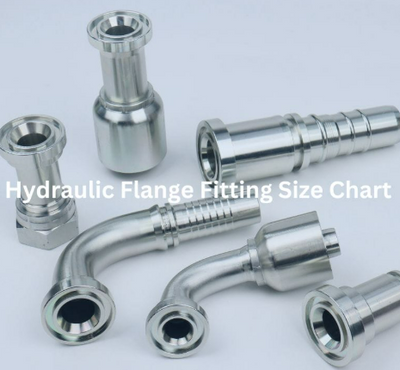
A hydraulic flange is often the better connection when a large or rigid conductor must meet a component port without rotating the tube, hose or fitting body. The flange head can be placed at the port and clamped, which changes the installation and service problem.
Pressure alone does not decide the choice. Geometry, access, loads and the governing connection standard matter together.
Start with the movement allowed during assembly
A large threaded joint needs rotation and wrench clearance. That can be difficult when a tube run is rigid, a hose end has an elbow, or nearby structure blocks tool swing. A flange head can approach axially and remain still while clamps and bolts are installed.
This does not mean the connection requires no clearance. Technicians still need access to position the seal, hold the conductor, install screws and follow the specified tightening sequence.
Select captive or split clamps from body geometry
A one-piece captive clamp can slide over a straight body when shoulder clearance permits. Angled or enlarged bodies may require two split halves installed around the flange head.
The clamp belongs to the connection series and size. Code 61 and Code 62 hardware should not be mixed, and an OEM head that appears to fit may use different thickness, groove or fastener details.
A kit is useful only when its O-ring, clamp halves, screws and washers are correct for the port and flange head.
Compare loads at the component port
Flanges distribute clamp load around the head and can be useful on larger conductors exposed to vibration or pressure transients. They do not eliminate side load from a forced route or unsupported hose.
Choose straight or elbow geometry so the conductor reaches the port naturally. Support weight and dynamic motion outside the joint. An adapter stack may defeat the reason for choosing a compact flange.
Use ratings for the exact series and size
SAE J518 and ISO 6162-family flange connections define specific ports, heads, seals and hardware. Code 61 is the standard-pressure family and Code 62 the higher-pressure family, but capability varies by size and completed product.
Do not rely on universal 5,000- or 6,000-psi statements. Check normal and transient pressure, temperature, material, seal, fasteners and the lowest-rated attached component.
Plan disassembly before final placement
A flanged joint can support zero-axial-clearance service because clamp halves can be removed without unthreading a long conductor. Verify that the hose or tube can be safely supported and moved enough to expose the O-ring and port face.
Place the connection where the groove can be cleaned and inspected. A flange hidden behind structure may still be harder to maintain than a suitable threaded joint.
Keep the seal compatible and inspectable
The O-ring provides the fluid seal; bolts provide clamping. Select the compound for the fluid and full temperature range. Inspect groove, face and seal before assembly and prevent paint or dirt from entering the joint.
A flange becomes the better choice when its non-rotating assembly, load distribution and service access solve real constraints. Without those advantages, a simpler verified threaded or face-seal connection may be more appropriate.