
Why JIC Still Works Well for Serviceable Hydraulic Lines
Aug 17th 2023
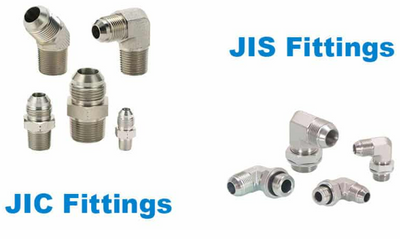
JIC fittings remain common because they combine a standardized 37-degree metal seal with a broad range of tube, hose, port, and adapter configurations. Technicians can disconnect the joint, see the sealing surface, and obtain many replacement shapes without introducing thread sealant at the flare.
Those advantages are practical rather than universal. JIC must still be selected from the exact component rating and installed without damaging or side-loading the flare.
Standardization supports mixed fleets and maintenance
SAE J514 defines the industrial 37-degree flare family. Dash sizes relate to nominal tube outside diameter, and each size pairs with a defined straight UN/UNF thread. This lets drawings, inspection tools, and stocked adapters share a common language across many hydraulic products.
The family includes straight unions, elbows, tees, bulkheads, reducers, hose ends, and adapters to ORB, ORFS, NPT, BSP, metric, flange, and other systems. A correct transition part allows legacy and new components to coexist while each boundary keeps its own seal.
Availability reduces repair delay, but only when bins preserve size, material, gender, and body configuration. A broad label such as “37-degree fitting” can mix industrial JIC with parts made to another specification.
The flare creates a visible fluid boundary
A JIC nut draws a female flare against a male 37-degree cone. The thread clamps; the conical metal contact seals. That arrangement avoids an elastomer at this particular union and makes dirt, scratches, corrosion, and witness marks accessible during service.
It also permits a swivel nut to be tightened without twisting the tube or hose. A swivel used for assembly is not necessarily designed for continuous rotation under pressure.
Because sealing does not depend on a tapered thread, a JIC elbow can be oriented by its body arrangement rather than by stopping an NPT thread at a fortunate turn. Routing still has to respect bend radius and prevent load at the flare.
Metal-to-metal sealing has real limits
The seats need alignment and suitable surface finish. A radial scratch can cross the sealing line. Overtightening can distort the tube flare or cone; insufficient tightening leaves incomplete contact. A rigid line forced into place can lever the faces apart during vibration.
JIC is not automatically leak-free, and no single working pressure applies to all JIC components. Larger sizes, elbows, materials, tube walls, hose assemblies, and temperatures can have different limits. Use the lowest applicable rating in the connected system.
Repeated assembly is possible only after inspection. A damaged seat should be repaired under an approved process or replaced—not covered with tape or an unverified soft washer.
Mobile and industrial systems value inspectability
Construction, agricultural, material-handling, test, and industrial equipment often combine movement, maintenance access, and a need for readily sourced replacements. JIC’s visible seat and body-shape variety address those conditions when routing and support are controlled.
In corrosive environments, material and finish must match fluid and external exposure. Carbon steel, stainless steel, and other options do not share one corrosion or galling behavior. Correct alloy documentation is separate from geometric compatibility.
Applications where fluid leakage consequences are especially high, assembly error must be minimized, or a flat elastomeric seal is preferred may use ORFS. Port connections may use ORB. These are not proof that JIC is obsolete; they place different seal designs at different locations.
Reliable replacement needs five confirmations
Before ordering, confirm dash size and thread, 37-degree male/female seat, material, body and opposite-end configuration, and service requirements. For a hose end, also match the exact hose, stem, ferrule, and crimp data.
During assembly, clean the faces, start the nut by hand, align the line, use the specified tightening method, and test safely. If leakage appears, find its true origin before applying more torque.
JIC continues to earn space in hydraulic systems because it is standardized, inspectable, serviceable, and available in many routing forms. It stays reliable when those benefits are supported by correct identification and controlled assembly rather than familiarity alone.