
Why the JIC 37-Degree Flare Still Anchors Hydraulic Repair Inventories
HGW Hydraulics on Mar 12th 2025
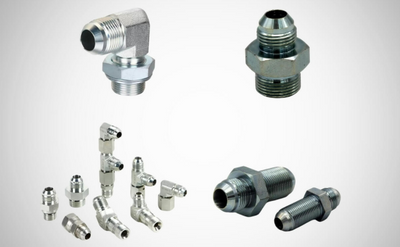
JIC fittings remain common because a large population of North American mobile and industrial equipment was designed around the 37-degree flare. That installed base influences hose ends, adapter drawers, maintenance skills, bills of material and emergency replacement decisions.
Longevity is not proof that JIC is best for every new circuit. It means the connection has a mature support system and must be evaluated against the actual leakage, vibration and service requirements.
The flare, not the straight thread, contains pressure
A JIC joint brings two matching 37-degree metal seats together. The straight thread and swivel nut provide clamping force; they are not a pipe-thread seal. Correct identification therefore requires the seat angle, thread size and mating form.
Inspect cones for scratches, cracks, distortion and embedded debris. A damaged seat cannot be repaired with thread tape. Extra torque may further deform the flare, split a thin tube end or hide the true failure until the joint is cycled.
Installed machines create recurring demand
Tractors, skid steers, harvest equipment, construction machinery and plant hydraulics may contain many JIC hose and tube transitions. Replacing like for like can restore the intended arrangement without adding conversion adapters or changing the hose assembly.
Distributors and repair shops consequently stock unions, elbows, tees, reducers, swivels and bulkheads in common JIC sizes. Familiarity shortens identification work, but technicians still need the correct material, size, orientation and rating for the circuit.
ORFS addresses a different sealing strategy
An O-ring face-seal connection compresses an elastomer in a groove against a flat mating face. It can be useful where machine design, cleanliness and service practice support a resilient face seal. JIC uses metal-to-metal contact and does not depend on a face O-ring.
Neither architecture guarantees “zero leakage.” ORFS performance depends on face condition, O-ring compound, groove dimensions and assembly. JIC depends on correct flare geometry, alignment and seat condition. Pressure capability varies by size, material and product specification for both families.
A conversion changes more than one adapter
Moving a circuit or fleet from JIC to ORFS can change hose-end tooling, crimp specifications, tube ends, adapters, port interfaces, service instructions and spare inventory. Added conversion adapters may increase length, side load and leak opportunities when clearance was designed for the original connection.
For a new design, compare routing, impulse, vibration, temperature, fluid, assembly error risk and maintenance access. For an existing machine, first determine whether recurring JIC leakage comes from worn flares, forced alignment, hose tension or poor assembly. Changing the seal family without correcting those loads can move the problem rather than solve it.
Maintain a controlled replacement record
Record dash size, thread, seat, material, body shape, pressure basis and connected hose or tube. Protect caps and sealing surfaces in storage, and do not mix a 37-degree JIC seat with visually similar 30- or 45-degree forms.
JIC continues to earn shelf space because it supports a broad installed equipment base. Its real advantage is a well-understood interface with available service parts, provided the replacement is identified and assembled as a 37-degree flare system.