
Identify NPT, BSPP, and ORB Ports from Geometry and Seal Location
HGW Hydraulics on Aug 23rd 2022
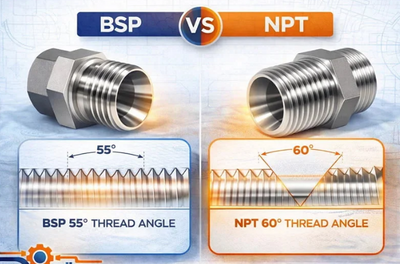
An unknown hydraulic port should be identified from measurable features, not from the fact that a fitting turns into it. NPT, BSPP, and SAE O-ring boss connections can have similar apparent diameters at some sizes, yet their thread forms and sealing locations are different. Partial engagement is not evidence of compatibility.
First determine whether the thread is tapered
NPT uses a 60-degree thread form on a taper. Male and female threads tighten by interference as engagement increases, and an approved pipe-thread sealant normally closes the spiral leakage path. The final assembly position, material, port strength, and sealant instructions matter because excessive tightening can crack or distort the female component.
BSPP and SAE ORB use parallel threads. Their threads provide retention rather than a tapered-thread seal. A parallel diameter should remain substantially constant when checked over several crests with the appropriate gauge or measurement method.
Next locate the intended seal
BSPP describes a thread family, not one universal sealing arrangement. Depending on the component, a BSPP end may seal at a bonded washer, captive elastomer, metal face, or cone seat. The mating component must provide the matching surface.
An SAE ORB male uses an O-ring at the port entrance. The port includes the geometry needed to support and compress that seal. Thread engagement without the correct O-ring, chamfer, and spotface cannot create the intended ORB connection.
NPT generally seals along the engaged tapered threads with suitable sealant. A visible O-ring near a straight-thread shoulder or a machined cone inside the port is therefore important evidence that the connection is not ordinary NPT.
Thread angle and pitch resolve close-looking sizes
NPT has a 60-degree profile, while BSP threads use a 55-degree Whitworth form. SAE ORB uses Unified straight threads with a 60-degree profile. Pitch must be checked separately because two different standards may be close enough to start by hand.
Use a clean male sample only as supporting evidence. The preferred process is to measure the outside or inside thread diameter, determine taper, use a pitch gauge, inspect the sealing surface, and compare the complete result with a recognized thread chart or port drawing. Worn threads and damaged first turns can distort any single measurement.
Stop when engagement does not match the expected connection
Do not use extra force, tape, or sealant to make an unidentified combination hold pressure. Cross-threading can damage an expensive manifold, while the wrong sealing geometry can leak even if the joint feels tight. Remove residual sealant and inspect the port for torn threads, cracks, or damaged seal surfaces before fitting a verified replacement.
When equipment must transition between standards, use an adapter intentionally manufactured with the identified connection on each end. Record both ends, nominal size, pitch, seal, material, and installed orientation. That information prevents the next maintenance team from treating a conversion point as one mixed or interchangeable thread.