
Stop Stainless Thread Galling Before the Fitting Begins to Seize
HGW Hydraulics on May 27th 2026
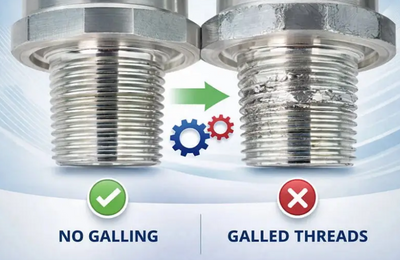
Stainless threads can feel normal for several turns and then lock abruptly. Continuing to apply torque may tear material from one flank to the other, weld microscopic contact points together, and leave both parts unusable. The useful time to prevent galling is before resistance rises, not after the fitting has seized.
Galling is adhesive wear under load and sliding. It should be distinguished from cross-threading, dirt, wrong pitch, damaged lead threads, and interference caused by an incorrect seal or coating.
Adhesion begins at microscopic contact points
Machined thread surfaces touch at high asperities rather than across their complete apparent area. As contact pressure and sliding increase, local junctions can deform and adhere. Continued rotation tears and transfers material, creating rougher high spots that accelerate the process.
The resulting friction rise can be mistaken for the joint reaching its intended tightness. In reality, the sealing faces may not yet be seated. Reversing a badly galled joint can remove thread material or fracture a component.
Austenitic stainless combinations deserve attention
Common austenitic grades such as 304 and 316 combine corrosion resistance with ductility and work-hardening behavior. When similar stainless surfaces slide under pressure, they can be susceptible to adhesive wear. Grade name alone does not predict a joint’s performance; cold work, hardness, finish, thread form, mating material, and treatment also matter.
Changing one side to a compatible dissimilar material, using an engineered surface treatment, or controlling hardness may reduce risk in a designed product. Such changes require material, corrosion, pressure, and fluid review. A field substitution of brass or another alloy is not an automatic safe fix.
Identification and alignment come first
Confirm thread family, diameter, pitch, class, and sealing mechanism. Similar metric, BSP, JIC, ORB, or pipe threads can begin to engage before binding. Galling prevention cannot correct a mismatched connection.
Inspect lead threads for dents, burrs, embedded particles, coating residue, and previous transfer. Align components coaxially and start them by hand without side load. A hose or tube that pulls the fitting off-axis should be rerouted or supported before tightening.
If a fitting does not turn through the expected free engagement, stop and identify the interference. Do not use a wrench to force initial engagement.
Surface cleanliness must not mean dry by default
Dirt or metal chips can raise local stress and initiate damage. Clean the connection with an approved method and keep process sealing surfaces protected.
Some stainless threaded assemblies require a specified lubricant or anti-seize compound; others prohibit it because of fluid compatibility, cleanliness, oxygen service, temperature, or torque calibration. Use only the approved material and amount. Lubrication changes the torque-preload relationship, so the torque instruction must cover the lubricated condition.
Anaerobic sealants and pipe compounds are not general anti-galling products. Their primary function and friction behavior differ.
Installation speed and torque affect heat and contact
Turn stainless threaded parts slowly and steadily. High-speed power tools can create frictional heating faster than it dissipates and make incipient seizure difficult to feel. Use a correctly sized, calibrated tool and a backup wrench where required.
Follow the fitting manufacturer’s assembly method rather than a universal torque chart. Stop if torque rises sharply or motion becomes jerky before the expected position. Do not repeatedly run a stainless fitting in and out to “smooth” it; each cycle changes the surface.
An adjustable fitting must be oriented using its designed locknut and backup components. Forcing the main body backward after seating can damage both threads and seal.
Design and procurement can reduce recurrence
For recurring assemblies, specify thread finish, material condition, dimensional control, cleanliness, approved assembly compound, and inspection criteria. Review whether the connection truly needs frequent disassembly or whether a swivel, flange, or replaceable adapter can protect an expensive port.
Incoming inspection can sample thread gauges and surface condition without mating every part. Lot traceability helps isolate a machining, heat-treatment, or finish issue if galling clusters in one batch.
Common service sizes may justify controlled spare adapters so a damaged sacrificial part can be replaced without improvising a different thread system.
Environment changes the assembly surface
High temperature can reduce lubricant film and increase local adhesion, while cold can change assembly feel and material behavior. Salt, process chemicals, washdown residue, and moisture can roughen or contaminate stored threads before they are ever installed.
Keep protective caps in place and store stainless parts away from carbon-steel grinding dust. Do not use a wire brush or tool that embeds incompatible metal in a sealing or threaded surface. If cleaning or passivation is required, follow a controlled process compatible with the finished component.
Oxygen, high-purity gas, food, pharmaceutical, or other cleanliness-controlled services can restrict lubricant choice. In those cases, an approved dry-film treatment, compatible material pair, or different connection design may be required. Never assume a common anti-seize compound is acceptable because it prevents galling in a general hydraulic application.
Repeated disassembly needs an inspection limit
Threads can burnish during a successful make-and-break cycle, changing friction on the next assembly. Marking from a wrench, slight pickup, or loss of coating can be an early warning even before full seizure.
Define whether the part is reusable, how many remakes are permitted if applicable, what surface condition is acceptable, and which seal must be renewed. A connection intended for frequent service may benefit from a replaceable adapter or swivel so the expensive manifold thread is not repeatedly loaded.
Treat a seized connection as damaged evidence
Depressurize, control stored energy, and support the equipment before attempting removal. Do not add heat or excessive force near hydraulic fluid, seals, or a pressure-retaining component without an approved repair process.
After separation, inspect both male and female threads. Transferred metal, torn flanks, dimensional damage, or cracks may require replacement rather than cleaning. If the female port is in a costly manifold, use qualified inspection and repair criteria.
Document material pair, lubricant, torque method, alignment, engagement, and where seizure began. That evidence distinguishes an installation issue from a systematic design or manufacturing problem.
Stainless galling is not proof that stainless steel was the wrong material. It is a signal that sliding contact, surface condition, material pairing, alignment, lubrication, or assembly control exceeded what the thread system could tolerate. Managing those variables before tightening preserves both corrosion resistance and serviceability.