
Add Hydraulic Connections Without Creating an Adapter Chain
HGW Hydraulics on Apr 15th 2021
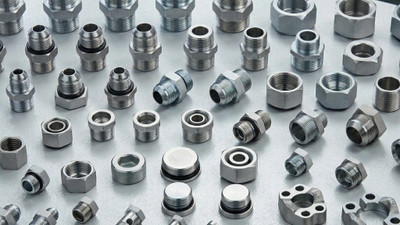
Adding a connection to a hydraulic system can solve a port mismatch, route a hose, reduce size, attach a tube, or create a permanent pipe branch. It can also create a chain of adapters with extra leak paths, restrictions, unsupported weight, and confusing standards.
The design should reach the required interface with the fewest verified transitions while preserving service access and pressure integrity.
ORFS moves the seal to a flat face
O-ring face seal connections use an O-ring in the male face against a flat female face. Straight threads and a nut maintain clamping. Tube assemblies can use formed ends or qualified sleeves, and hose ends can mate through the appropriate swivel.
Identify thread size, face dimensions, O-ring compound, tube or hose size, body geometry, and rating. Inspect the groove and mating face for scratches. The elastomer does not make the joint automatically leak-proof or suitable for every vibration level.
SAE J1453 covers defined ORFS connection geometry and requirements; the actual component revision and manufacturer data remain part of selection.
ORB creates a sealed component port
SAE straight-thread O-ring boss uses an O-ring on the male fitting that seals in a female port chamfer. The spotface supports the joint and adjustable elbows or tees use a locknut and backup arrangement for orientation.
Do not treat ORB as a hose swivel or pipe-thread seal. Confirm port size, O-ring, adjustable versus non-adjustable assembly, and the required orientation. A damaged chamfer or spotface cannot be repaired with pipe sealant.
The source’s reference to “ISO 11296-1” is not a valid substitute for identifying the applicable SAE/ISO port standard; use the controlled drawing or current specification for the actual part.
Adapters should resolve one defined mismatch
An adapter can convert JIC to ORB, ORFS to metric, BSP to NPT, hose to port, male to female, or one size to another. Before selecting it, document both interfaces independently. A description such as “metric-to-pipe” is incomplete without thread, pitch, taper, seat, seal, and size.
Increasing thread size does not increase the bore or flow capacity of upstream components. A reducer or small internal stem can raise velocity and pressure loss. Check the minimum passage and peak flow.
Multiple stacked adapters increase overall length and bending moment at the port. A single controlled special adapter or revised hose end may be safer when geometry is recurring and documented. Do not create a custom part without drawing, material, rating, inspection, and change control.
Hose barb connections belong to qualified hose service
Barb fittings grip the inside of compatible hose with clamps, ferrules, or other retention specified for the assembly. Hose inside diameter, material, wall, fluid, pressure, temperature, and retention method must match.
A general utility barb is not a substitute for a crimped high-pressure hydraulic hose end. Likewise, PTC pneumatic tubing, process hose, and hydraulic hose require different fitting systems even when nominal sizes resemble one another.
Weld-on fittings create a permanent transition
Socket-weld, butt-weld, and weld-on hydraulic adapters have different joint preparation and code requirements. A socket arrangement receives pipe or tube into a recess and is fillet welded as designed; a butt weld aligns prepared ends for a full penetration joint.
Size limits, pressure, temperature, cyclic service, hazardous fluid, welder qualification, procedure, heat treatment, inspection, and cleanliness are application-specific. Do not apply universal diameter, steam-pressure, or “leak prohibited” claims from a generic article.
Weld spatter and heat can damage nearby seals. Complete welding, inspection, cleaning, and flushing before installing vulnerable elastomers when the procedure permits.
The lowest qualified component controls
Assembly capability is limited by the hose, tube, fitting body, adapter, port, weld, seal, valve, and temperature derating. A 3,000 psi hose does not create a 3,000 psi assembly if its end, adapter, or mating component is rated lower.
Do not mix hose stems and ferrules between manufacturers without documented qualification. Thread interchangeability also does not prove pressure or material equivalence.
Record ratings under the same basis. Working, proof, and burst pressures have different meanings and should not be compared as if they were one value.
Design for maintenance and inventory
Provide wrench clearance, backup-wrench surfaces, O-ring access, tube alignment, and hose motion. Keep heavy transitions supported so they do not load a valve or manifold port. Place test points where technicians can connect rated equipment without dismantling the primary line.
For stocked adapters, label both ends and keep similar BSP, NPT, metric, JIC, ORB, and ORFS parts separated. Link a verified drawing and approved manufacturer to each internal number. Quarantine near-matches and revision discrepancies.
Test the transition at its real duty point
After installation, inspect the connection at operating temperature, pressure, flow, and machine motion using the approved startup procedure. A static shop leak test may not reveal a hose pulling on an elbow, a return restriction during fast cylinder movement, or a seal that changes under thermal cycling.
If a converted connection leaks, preserve evidence before adding torque. Check whether the leak is at the new adapter’s first seal, second seal, body, weld, hose crimp, or original port. Different causes require different correction.
For production equipment, update the schematic and bill of material so the new transition does not remain an undocumented field modification. Record why it was added, rating basis, drawing revision, seal material, installation instruction, and approved replacement.
When replenishment involves overseas production and U.S. stock, keep common verified adapters locally according to demand and total lead time. Unusual specials can remain controlled-order items, but drawing and first-article evidence should be complete before an emergency need occurs.
Additional fitting types are useful when each one performs a clear transition. ORFS, ORB, hose ends, adapters, and weld-on connections should simplify the fluid path and make its seals understandable—not become a stack of visually compatible compromises.