
HGW Resources

HGW Blog

Practical guides for identifying hydraulic fittings, comparing connection styles, checking applications, reviewing materials, and finding relevant HGW product categories.

Fitting Guides

Select a Solenoid Valve from Its De-Energized State and Pressure Differential

HGW Hydraulics on Jul 22nd 2026

A solenoid valve combines an electromagnetic operator with a fluid-control element. An electrical command moves an armature or plunger, which directly changes a seat or pilots a larger valve stage. The first selection question is what flow path the valve must create when power is absent. Draw the normal and energized flow paths “Normally closed” means the specified passage is blocked in the de-ene
Fitting Guides

Use a Custom Hydraulic Fitting Only After Defining the Leak Mechanism

HGW Hydraulics on Apr 2nd 2026

A custom fitting can replace an awkward adapter stack, resolve clearance or align unlike approved interfaces. It should not be the first response to an unidentified leak. If a damaged seat, hose tension or wrong O-ring caused the problem, a special body can reproduce it at higher cost. Document where pressure escapes Clean the area and identify the actual sealing interface: tapered thread, flare,
Fitting Guides

Use Push-In Fittings When Tube Preparation and Access Stay Controllable

HGW Hydraulics on Dec 16th 2025

Push-in fittings can eliminate flaring, soldering, solvent curing or compression-nut make-up in selected systems. Their installation speed is real only when tube preparation, insertion and later inspection remain controlled. A joint hidden behind a panel deserves more—not less—evidence before it is closed in. Compare complete joining methods Soldered metal pipe, solvent-cemented plastic, compressi
Fitting Guides

Controlling Hydraulic Speed Without Confusing Flow, Pressure, and Direction

HGW Hydraulics on Oct 29th 2025

A slow cylinder is not automatically a low-pressure problem, and a higher pressure setting does not automatically make an actuator move faster. Hydraulic motion comes from a relationship among available flow, the load, the actuator geometry, the valve state, and losses along the path. Troubleshooting becomes clearer when the circuit is divided into three questions: where does the fluid volume come
Fitting Guides

Instrumentation Tube Fitting Selection Starts with the Tube Specification

HGW Hydraulics on Oct 21st 2025

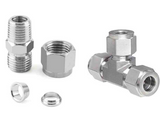
An instrumentation fitting cannot make an undefined tube reliable. The tube supplies the surface that ferrules grip and seal, the wall that carries pressure, and the material exposed to the fluid and environment. Selection should therefore begin with tube alloy, outside diameter, wall, hardness, surface condition, and dimensional tolerance. Only then can a compatible fitting, ferrule system, press
Fitting Guides

Hydraulic Flow Rate, Line Velocity, and Actuator Speed Are Three Different Checks

HGW Hydraulics on Oct 2nd 2025

Flow rate is fluid volume per unit time. Line velocity is the average speed of that volume through a passage. Actuator speed is the motion of a cylinder or motor created by flow and actuator displacement. Treating the three as synonyms can produce undersized hoses, excessive pressure loss, slow motion, or damaging inlet conditions. The design must satisfy all three under the machine’s duty cycle.
Fitting Guides

Measure Push-to-Connect Labor Savings Without Expanding the Application

HGW Hydraulics on Sep 4th 2025

Push-to-connect fittings can reduce assembly time on approved small-tube circuits. The saving comes from a repeatable cut-and-insert process, not from eliminating tube preparation or application review. Before comparing labor cost, separate a push-in tube fitting from a quick-disconnect hose coupling or a safety breakaway. Similar marketing names describe different retention, valve and pressure fu
Fitting Guides

Design a Hydraulic Circuit from Energy Demand to Safe Maintenance

HGW Hydraulics on Aug 21st 2025

Hydraulic system design begins with the work an actuator must perform, not with a list of available pumps and fittings. Load, speed, duty and control response establish flow and pressure demand; every later component must support that operating envelope. A maintainable circuit turns those calculations into a route that can be isolated, inspected and repaired safely. Define the motion and credible
Fitting Guides

Turning Hydraulic Machine Requirements into a Safe, Serviceable Circuit

HGW Hydraulics on Aug 6th 2025

Hydraulic design begins with the work the machine must perform, not with a preferred pump or fitting. Force, torque, speed, travel, cycle, precision, load direction, environment, and failure consequence become pressure, flow, displacement, heat, control, and safety requirements. This sequence prevents an efficient component from being installed in a circuit that cannot meet the real duty. Quantify
Fitting Guides

Design the Hydraulic Conductor Path before Choosing Individual Fittings

HGW Hydraulics on Jul 1st 2025

Pumps, valves and actuators cannot perform as intended if the conductors between them add excessive restriction, trap contamination or carry mechanical loads into component ports. Pipe, tube, hose and fittings should be designed as one network before individual part numbers are selected. The route determines how hydraulic power reaches the load and how safely the system can be maintained. Map flow