
Controlling Hydraulic Speed Without Confusing Flow, Pressure, and Direction
HGW Hydraulics on Oct 29th 2025
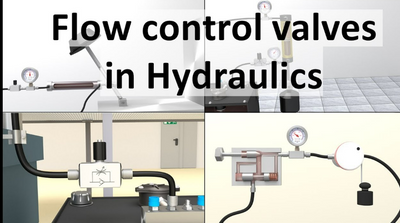
A slow cylinder is not automatically a low-pressure problem, and a higher pressure setting does not automatically make an actuator move faster. Hydraulic motion comes from a relationship among available flow, the load, the actuator geometry, the valve state, and losses along the path.
Troubleshooting becomes clearer when the circuit is divided into three questions: where does the fluid volume come from, where is it directed, and what restricts or consumes that flow?
The pump supplies volume, while the load establishes pressure
A positive-displacement pump carries a volume of fluid from its inlet to its outlet during each cycle. Its inlet must receive oil from the reservoir without excessive restriction, and its drive must supply the required mechanical power.
Pressure develops when pump delivery encounters resistance. That resistance may come from an external load, an actuator, a valve opening, line friction, or a blocked path. If the load increases, pressure can rise while actuator speed remains nearly unchanged until leakage, compensation, power limits, or a relief valve changes the delivered flow.
This is why raising a relief setting is not a valid first response to slow movement. The actual flow at the actuator should be checked before changing a safety or pressure-control setting.
Actuator size converts flow into speed
For a cylinder, ideal linear speed is volumetric flow divided by the effective piston area. The rod reduces area on one side, so extension and retraction can have different speeds at the same incoming flow. Internal leakage and fluid compressibility reduce the real result.
For a hydraulic motor, speed depends mainly on inlet flow and motor displacement, adjusted for volumetric efficiency. Required torque is related to pressure difference and displacement. Flow and pressure therefore describe different parts of the operating point.
Peak return flow also matters. During cylinder movement, the volume leaving one chamber may not equal the pump flow entering the other chamber. Return hoses, valves, filters, and coolers must accept the actual discharge condition.
Metering valves change motion by creating a controlled restriction
A flow-control valve meters the volume sent to an actuator. A simple needle or variable orifice changes flow by changing passage area, but the result also varies with pressure difference and fluid viscosity. A pressure-compensated control can maintain a more consistent setting as load changes within its operating range.
Meter-in control restricts flow entering an actuator. Meter-out control restricts the leaving side and can help manage overrunning loads when the circuit is designed for it. A bypass or priority arrangement can divide available pump flow among functions. These architectures are not interchangeable, and each can generate heat when pressure is dissipated across a restriction.
General process valves such as gate, butterfly, or diaphragm valves may appear in fluid systems, but they are not automatically suitable for precise hydraulic speed control. Component selection must account for pressure, dynamic response, contamination tolerance, fluid compatibility, and the intended metering function.
Directional valves decide which path is active
A directional control valve connects pressure, actuator, and tank ports in defined spool positions. Its neutral condition may unload a fixed-displacement pump, block an actuator, connect work ports to tank, or support another circuit behavior.
The valve also has internal passage areas and flow ratings. A valve selected only by port thread may cause excessive pressure drop, heat, or poor response. Center condition, actuation method, fail position, rated flow, allowable pressure, and the schematic symbol all need to match.
Proportional and servo valves can meter and direct fluid in one device, but accurate motion then depends on valve dynamics, feedback, electronics, filtration, and tuning as well as hydraulic sizing.
Volumetric flow is usually the useful circuit measurement
Mass flow describes mass passing a point per unit time and includes density. Hydraulic pumps and actuators are normally sized with volumetric flow, such as gallons per minute, because displacement and chamber volume are geometric quantities.
Average line velocity is volumetric flow divided by internal area. A smaller hose, fitting stem, coupler, or manifold passage raises velocity for the same flow and can increase loss. Nominal port size alone does not reveal the smallest effective passage.
Diagnose speed along the complete route
Record commanded motion, load, oil temperature, pump speed, pressure at relevant points, and measured flow. Compare the pump outlet with the actuator inlet and check the return path. A worn pump, an open bypass, internal cylinder leakage, a restricted filter, an undersized fitting, or a partially shifted valve can produce similar symptoms for different reasons.
Use properly rated test equipment and the machine’s safe service procedure. Do not loosen a live fitting to estimate flow.
Hydraulic speed control is not one component. It is the result of pump delivery, valve metering, directional logic, actuator displacement, and the pressure losses between them. Keeping those roles separate leads to safer adjustments and more accurate replacement decisions.