
Design a Hydraulic Circuit from Energy Demand to Safe Maintenance
HGW Hydraulics on Aug 21st 2025
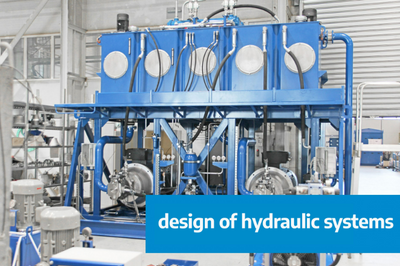
Hydraulic system design begins with the work an actuator must perform, not with a list of available pumps and fittings. Load, speed, duty and control response establish flow and pressure demand; every later component must support that operating envelope.
A maintainable circuit turns those calculations into a route that can be isolated, inspected and repaired safely.
Define the motion and credible loads
For each cylinder or motor, document force or torque, speed, travel, holding needs, direction changes and duty cycle. Include gravity, inertia, shock and failure states rather than only nominal operation.
These requirements inform actuator size, flow and pressure. They also determine whether load-holding, counterbalance, braking or other safety controls are needed.
Build the power and control path
The prime mover drives a pump that creates flow. Valves route, limit or regulate that flow, and actuators convert hydraulic energy into motion. Reservoir, filters, coolers, accumulators and sensors support the circuit.
Select pump and control architecture for the duty instead of continuously wasting excess flow across a relief valve. Account for efficiency and heat rejection at sustained operating conditions.
Size conductors as a network
Choose pipe, tube, hose and fittings by segment pressure, flow, viscosity, temperature, motion and allowable loss. A restricted inlet can harm pump performance, while undersized returns and valves can generate heat.
Support lines without transferring vibration and weight into ports. Preserve hose bend radius and tube alignment. Component placement should keep filters, test points and shutoff devices accessible.
Select materials from the actual environment
Steel, stainless, brass, aluminum, polymers and higher alloys have different strength, corrosion, temperature and fluid-compatibility limits. Use exact finished-component ratings and applicable standards.
Do not justify titanium or another expensive material with a generic ultra-high-pressure number. Material, geometry, fabrication and qualification form the pressure boundary together.
Seals and hose inner tubes may set lower temperature or fluid limits than metal bodies.
Design contamination and thermal control
Set cleanliness targets from component sensitivity and use filters, breathers, flushing and clean assembly to achieve them. Position sampling and differential-pressure monitoring where they provide usable evidence.
Estimate heat generation and cooling across the real duty cycle. High temperature can indicate throttling, leakage, inadequate cooling or wrong fluid; it should not be solved by component substitution alone.
Make stored energy visible to maintenance
Provide safe means to lower or support loads, isolate power, release accumulator and trapped pressure, and verify zero-energy state under the equipment procedure. Locate drains and caps so fluid can be controlled during service.
Create schematics, port labels, setpoint records and a controlled bill of materials. Maintenance cannot compensate for a circuit whose critical isolation points or replacement identities were never designed.
Hydraulic reliability emerges from interactions. The design is complete when the machine performs its duty and technicians can understand, isolate and restore it without improvisation.