
Design the Hydraulic Conductor Path before Choosing Individual Fittings
HGW Hydraulics on Jul 1st 2025
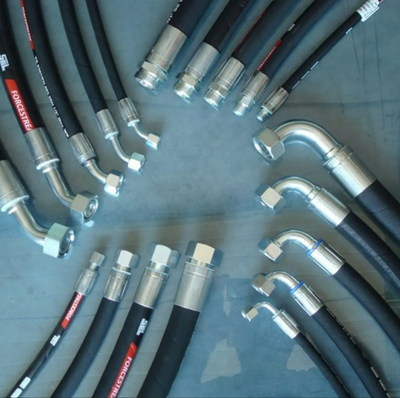
Pumps, valves and actuators cannot perform as intended if the conductors between them add excessive restriction, trap contamination or carry mechanical loads into component ports. Pipe, tube, hose and fittings should be designed as one network before individual part numbers are selected.
The route determines how hydraulic power reaches the load and how safely the system can be maintained.
Map flow and pressure by circuit segment
Pressure, return, suction, drain and pilot lines serve different functions. Establish required flow, normal and transient pressure, allowable pressure loss, fluid viscosity range and cleanliness for each segment.
Inside diameter controls velocity and pressure drop, while fittings, elbows, valves and abrupt reductions add local losses. A line that matches port thread size can still be too restrictive.
Suction conductors need special attention to inlet conditions and air entry. Case drains and returns should not be treated as generic low-consequence lines without the component requirements.
Assign rigid and flexible sections deliberately
Pipe can serve fixed industrial runs under the applicable piping design. Bent tube can create compact, low-volume routes with fewer joints. Hose accommodates relative movement, vibration and service removal.
Hose should not replace tube merely because it is easier to route, and rigid tube should not bridge moving components. Compare minimum bend, fatigue, pressure, temperature, external abrasion and installation envelope.
At transitions, support conductors so their weight and motion do not bend a port or fitting.
Make each connection reveal its seal
Record whether pressure is contained by tapered thread, flare, face O-ring, boss O-ring, ferrule, washer or flange. Retaining threads that look similar can clamp different seals.
Choose body shape and orientation from the route. A technically correct elbow can still load a hose if its centerline or clocking is wrong.
Minimize adapters where a direct verified end is available, but retain a conversion when it protects an imported equipment port and standardizes a replaceable hose.
Design for temperature and environment
Internal fluid temperature and external heat, cold, salt, washdown, chemicals and debris affect different layers of the conductor. A stainless fitting cannot upgrade an incompatible hose tube or O-ring.
Provide guards for a defined abrasion, heat or spray hazard without hiding inspection areas. Drain or clean locations where sleeves and clamps collect contamination.
Plan isolation and service access
Place connections where technicians can depressurize, cap, inspect and tighten them with the correct tools. Avoid hidden joints that cannot be examined and conductors that must be forced aside to replace a filter or valve.
Label critical lines and record hose length, tube geometry, end standards and orientation. Local U.S. spares reduce downtime only when they match the controlled configuration.
Verify the network under real operation
After clean assembly, check pressure loss, temperature, noise, motion, leakage and support behavior across the duty cycle. Reinspect after initial operation or a routing change.
Reliable conductors are not passive plumbing. They are the designed path that connects hydraulic energy, machine movement and maintainable pressure boundaries.