
Turning Hydraulic Machine Requirements into a Safe, Serviceable Circuit
HGW Hydraulics on Aug 6th 2025
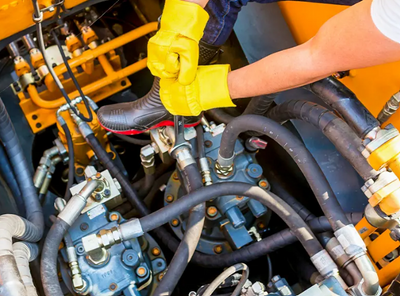
Hydraulic design begins with the work the machine must perform, not with a preferred pump or fitting. Force, torque, speed, travel, cycle, precision, load direction, environment, and failure consequence become pressure, flow, displacement, heat, control, and safety requirements.
This sequence prevents an efficient component from being installed in a circuit that cannot meet the real duty.
Quantify load and motion
Define maximum and typical force or torque, speed, acceleration, stroke, duty cycle, simultaneous functions, holding time, and allowable drift. Include friction, inertia, gravity, shock, and external load changes.
Cylinder force relates to pressure and effective area; speed relates to flow and area. Motor torque and speed relate to displacement, pressure, flow, and efficiency. Apply realistic losses and safety margins under the governing design method.
Select an architecture before individual parts
Decide between open-circuit, closed hydrostatic, load-sensing, pressure-compensated, accumulator-assisted, servo/proportional, or other arrangements based on function. Define normal, startup, shutdown, fault, and emergency states on a schematic.
Choose pump displacement and control, actuator, directional and pressure valves, filters, reservoir, cooler, sensors, accumulators, and prime mover as a system. Ratings must cover pressure, temperature, flow, fatigue, contamination, and environment.
Size lines for flow and movement
Hose, tube, pipe, manifolds, and fittings need bore suitable for acceptable velocity and pressure loss. Route around heat, impact, abrasion, tight bend, and moving structure. Support rigid lines and avoid loading component ports.
Identify each JIC, ORFS, ORB, NPT, BSP, metric, flange, or tube connection by its seal. Material, seal compound, coating, and assembly must suit the media and environment.
Control energy losses
Continuous relief flow, excessive throttling, oversized pumps, internal leakage, restrictive lines, and poor cooling convert input power to heat. Variable displacement, load sensing, variable-speed drives, accumulators, regenerative circuits, and right-sized components can reduce losses where their complexity is justified.
Analyze the full duty cycle rather than peak efficiency at one point. Recovery hardware can add pressure drop or control risk if poorly integrated.
Choose fluid with the components
Viscosity across startup and operating temperature affects inlet performance, leakage, lubrication, and efficiency. Check base fluid, additives, seal compatibility, fire behavior, environmental requirements, oxidation, air release, water handling, and filtration.
Design filling, sampling, breathers, offline filtration, flushing, and contamination targets. The cleanest component cannot survive dirty assembly practice.
Make safety and maintenance physical features
Provide pressure relief, load holding, guards, mechanical blocking, accumulator isolation, bleed points, rated test ports, clear gauges, labels, and safe access. Locate filters, valves, drains, sensors, and connections where they can be serviced without reaching through hazards.
Use risk assessment and applicable machinery, pressure, electrical, and functional-safety standards. Redundancy should address common-cause failures, not only duplicate hardware.
Verify requirements before release
Review calculations, schematics, component data, thermal balance, structural loads, control logic, failure modes, hose motion, cleanliness, and test plans. Prototype or simulate uncertain behavior, then test pressure, flow, temperature, motion, leakage, noise, and safe states.
Document settings, software, drawings, parts, fluids, and acceptance evidence. Maintain configuration control after field changes.
A good hydraulic circuit is the traceable result of machine requirements. When pressure, flow, fluid, connections, controls, efficiency, and maintenance all point back to the intended work, the system can perform without hiding risk inside a collection of individually capable parts.