HGW Resources

HGW Blog

Practical guides for identifying hydraulic fittings, comparing connection styles, checking applications, reviewing materials, and finding relevant HGW product categories.

Fitting Guides

Following Energy Through a Hydraulic Circuit

HGW Hydraulics on Jun 25th 2025

A hydraulic system does not create energy at the cylinder. A motor or engine drives a pump, the pump moves fluid, valves control its path and pressure, and an actuator converts hydraulic power into force and motion. The reservoir, filters, cooler, lines, seals, and controls keep that energy transfer usable. Following this path explains why pressure and flow are related but not interchangeable: pre

Fitting Guides

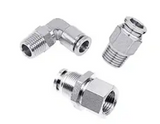
Match Push-to-Connect Fittings to Tube, Media, and Approval

HGW Hydraulics on Jun 17th 2025

A push-to-connect fitting combines tube retention and sealing inside a compact body. When the tube is prepared and inserted correctly, installation can be completed without solder, adhesive or a compression-nut pull-up. That convenience is valid only inside the product’s approved tube and service envelope. Follow the internal parts from entry to stop The tube first passes a release sleeve or colle
Fitting Guides

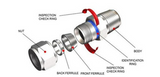
Diagnose Back Ferrule Damage from Tube Grip, Motion, and Assembly Evidence

HGW Hydraulics on Dec 24th 2024

A back ferrule is one part of a precision tube-fitting system. Its exact job varies with the design, but it commonly contributes tube grip and load control while the front ferrule establishes the primary seal. Damage at the back ferrule is evidence to investigate, not proof that all dual-ferrule connections are unreliable. Before replacing pieces, preserve the component order, tube location and op
Fitting Guides

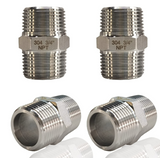
Choose a Stainless Pipe Nipple by End Preparation and Wrench Access

HGW Hydraulics on Sep 3rd 2024

A pipe nipple is a short tubular connector, but its useful identity includes end preparation, overall length, unthreaded center, bore, material, schedule or wall, and wrench access. Two male threads do not guarantee a seal or pressure rating. The nipple and both female components must follow the same specified pipe-thread system and service limits. Barrel nipples leave a usable center section A ba
Fitting Guides

Specify Brass Push-On Hose Fittings as a Qualified Hose System

HGW Hydraulics on Jun 25th 2024

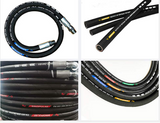
A brass push-on hose fitting can provide a fast connection without a production crimp, but only within a matched hose-and-fitting system. The fact that a barb enters the hose does not authorize clamp-free service or establish pressure capability. Identify the dedicated hose and retention design Record hose manufacturer and family, inside diameter, wall, reinforcement, temperature, fluid, pressure,
Fitting Guides

Prepare Tube for Push-In Fittings Without Scratching the O-Ring or Collet

HGW Hydraulics on May 29th 2024

A push-in fitting is fast only after the tube and application have been verified. Its collet or gripping element must hold the tube while an internal seal contains the fluid or gas. A jagged cut, wrong outside diameter, surface scratch, or unapproved media can defeat either function. Confirm the fitting family and application Identify tube OD, material, wall, hardness, pressure or vacuum, temperat
Fitting Guides

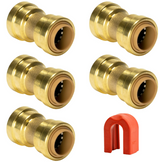
Choose Composite or Brass Push-In Fittings from the Tube System

HGW Hydraulics on May 14th 2024

Composite and brass push-in fittings can terminate tubing with the same basic collet-and-O-ring idea, yet body material changes weight, threads, environment and failure modes. Neither choice is complete until the exact tubing and application approval are known. Begin with the tube system, then compare the body. Define the push-in interface Record tube outside diameter, material, wall, hardness and
Fitting Guides

Hydraulic Quick Couplers: Locking, Internal Valves, Pressure, and Safe Disconnection

HGW Hydraulics on Feb 14th 2024

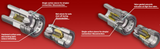
Hydraulic quick couplers let a hose or tool be connected without assembling a threaded joint each time. A plug enters a socket, a locking mechanism retains it, seals contain the fluid, and internal valves—when present—open to create a flow path. The convenience depends on correct series matching and safe pressure control. Two halves that look similar may have different profiles, seals, valve mecha
Fitting Guides

Instrumentation Valve Selection by Function, Isolation Plan, and Process Conditions

HGW Hydraulics on Jan 18th 2024

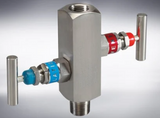
Instrumentation valves do more than open and close a small line. They isolate instruments, meter samples, prevent reverse flow, route test connections, and create controlled bleed paths. The right valve begins with the process function and failure consequence, then moves to materials, sealing, actuation, and port details. A catalog pressure value cannot replace this system definition. Pressure flu
Fitting Guides

Using STAMP to Define a Hydraulic Fitting Before Ordering

HGW Hydraulics on Jan 3rd 2024

STAMP is a compact way to collect the conditions a hydraulic fitting must satisfy: size, temperature, application, media, and pressure. It does not select a part automatically. It prevents the buyer from choosing by thread label while leaving the tube, seal, environment, or pressure cycle undefined. Use STAMP at the system boundary where the fitting will be installed. Record the two mating compone