
Hydraulic Quick Couplers: Locking, Internal Valves, Pressure, and Safe Disconnection
HGW Hydraulics on Feb 14th 2024
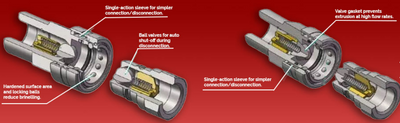
Hydraulic quick couplers let a hose or tool be connected without assembling a threaded joint each time. A plug enters a socket, a locking mechanism retains it, seals contain the fluid, and internal valves—when present—open to create a flow path.
The convenience depends on correct series matching and safe pressure control. Two halves that look similar may have different profiles, seals, valve mechanisms, pressure ratings, or standards and should not be test-fitted under pressure.
Locking and sealing are separate functions
Ball bearings, locking lugs, segmented retainers, sleeves, and other mechanisms can hold the plug in the coupler. The sleeve or button releases that retention according to the design. An elastomeric seal around the plug controls external leakage.
Valved quick couplers usually contain spring-loaded poppets or flat-face elements. When the halves connect, each side opens; during disconnection, the valves close to limit fluid loss and air entry. Unvalved designs leave an open passage and require a different isolation procedure.
The locking click is not the complete acceptance check. Pull back gently as instructed, verify the sleeve returned to its locked position, and inspect for full engagement.
Connection profile controls interchangeability
Industry standards define some interchangeable profiles, while many product series are proprietary. Matching nominal body size is not enough. Confirm standard or series, plug profile, flow direction, pressure class, valve type, seal, and material on both halves.
Mixing halves can produce shallow lock engagement, damaged valves, excessive pressure drop, or a connection that separates under load. When replacing an unknown coupler, retain both halves or identify the equipment and original part numbers.
Choose valve style from spill and pressure needs
Poppet-style couplers are common and economical. Flat-face designs can reduce trapped volume, fluid loss, and contamination exposure during frequent tool changes. Connect-under-pressure designs use specialized mechanisms and have defined residual-pressure limits.
Do not force an ordinary coupler against trapped pressure. High insertion force is evidence to depressurize or use the system’s approved pressure-relief procedure. Likewise, disconnecting a loaded line can eject hot fluid, damage the lock, or propel the hose.
Flow capacity and pressure drop matter as well as nominal line size. Internal valves and compact passages can restrict the circuit and generate heat. Review flow curves for the selected size and fluid viscosity.
Material and seal selection follows both environments
Carbon steel with an appropriate finish is common in hydraulic equipment. Stainless steel may be selected for compatible corrosive, washdown, or process conditions. Brass and polymers serve other fluid, pneumatic, or lower-demand applications. Material name alone does not define pressure or temperature capability.
Seal compound must suit the hydraulic fluid, temperature, cleaning agents, and external exposure. The dust cap material and coupling finish also affect outdoor storage and contamination control.
Body shape—straight, bulkhead, elbow, tee, panel mount, or multi-coupling plate—should support the route without adding hose bend or side load.
Disconnect under a controlled safe state
Follow the machine and coupler manufacturer’s procedure. Lower suspended loads, isolate energy, shut down the system, and relieve pressure on both sides. Confirm that trapped accumulators, thermal expansion, or tool cylinders cannot restore pressure.
Clean around the joint, operate the release sleeve or button as designed, separate the halves without placing hands near a suspected leak, and cap both ends immediately. Inspect the plug nose, lock groove, balls or lugs, sleeve, valves, and seals before reuse.
Hydraulic injection injuries require immediate emergency medical treatment even when the puncture looks small. Never check a pinhole with bare or gloved fingers.
Maintenance is based on condition and cycle
Replace a coupler that will not lock positively, has a damaged plug groove, leaks beyond the allowable condition, shows cracked or corroded load-bearing parts, or has valves that stick. Follow approved seal-replacement procedures; an O-ring of similar appearance may have the wrong size or compound.
Record coupler series, body size, end connection, material, seal, valve style, flow requirement, operating conditions, and equipment location. Keeping matched caps and labeled halves prevents contamination and wrong-series mixing.
Quick couplers reduce downtime when their lock, seal, internal valves, and system pressure are treated as one connection. Safe tool-free handling is the result of a controlled design and procedure, not permission to connect or release any line by hand.