
Choose a Stainless Pipe Nipple by End Preparation and Wrench Access
HGW Hydraulics on Sep 3rd 2024
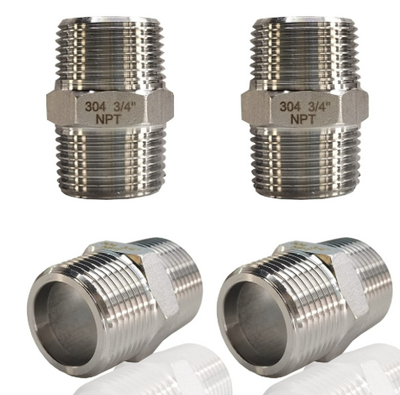
A pipe nipple is a short tubular connector, but its useful identity includes end preparation, overall length, unthreaded center, bore, material, schedule or wall, and wrench access. Two male threads do not guarantee a seal or pressure rating. The nipple and both female components must follow the same specified pipe-thread system and service limits.
Barrel nipples leave a usable center section
A barrel nipple normally has male threads at both ends with an unthreaded section between them. The center length separates two female components and can provide handling or wrench space when the product design permits.
Specify nominal pipe size, thread standard, overall length, thread length, wall or schedule, bore, and material. NPT and BSPT can both be tapered yet are not interchangeable. Approved sealant and engagement follow the thread and application instructions.
Threaded-one-end nipples create a transition blank
A threaded-one-end nipple has one prepared male thread and one plain end. The plain end may be intended for welding, fabrication, tank connection, or another controlled process. Its purpose should be stated; an unfinished end is not automatically suitable as a structural leg or pressure weld.
Define cut, bevel, wall, alloy, weld procedure, cleaning, and inspection for the plain end. Protect the thread from weld heat and contamination as required.
Close and shoulder nipples trade access for compactness
A close or running nipple has threads extending over nearly its entire length so the connected female fittings sit close together. With little or no unthreaded surface, removal can damage the thread because a pipe wrench has nowhere clean to grip.
A shoulder nipple provides a small unthreaded center between the threaded ends, but it may still offer limited tool access. Use these forms only where the compact envelope is necessary and the installation plan accounts for tightening and later service.
Do not install one end by driving force through damaged threads needed for the second seal. A hex form may be better where planned removal matters.
Hex nipples provide controlled wrench flats
A hex nipple has a central hexagonal body that can be held with a wrench while each end is assembled. It can connect equal pipe sizes or be made as a reducing hex nipple. The body also changes flow bore and pressure geometry from a simple pipe section.
Use the specified wrench size and torque or engagement. The flats improve access but do not authorize over-tightening a tapered female port.
Reducing nipples need a flow and strength review
A reducing or unequal nipple connects two nominal sizes. It can simplify an adapter stack, but the smaller bore may increase velocity and pressure loss. Wall transitions and thread roots can affect rating.
Record both ends in order, flow direction if the system requires it, and the finished-component pressure-temperature data. Do not describe the reducer as a way to create desired pressure; it changes geometry, while valves and system controls establish pressure behavior.
Hose nipples and weld nipples are complete end systems
A hose nipple combines a pipe thread with a barb or hose stem. Match the hose ID, material, reinforcement, pressure, temperature, fluid, and clamp or ferrule instruction. A generic hose barb is not a high-pressure hydraulic hose end.
A weld nipple combines a threaded end with a weld-prepared plain end. Confirm alloy, wall, bevel, filler, procedure, purge, inspection, cleaning, and pressure code. A 316 body can lose intended corrosion performance if fabrication is uncontrolled.
Verify stainless grade and every mating surface
304 or 316-family stainless may be selected for corrosion, cleaning, or process requirements. Chlorides, crevices, galling, and dissimilar metals remain concerns. Use approved thread lubricant or sealant and prevent carbon-steel contamination where required.
For procurement, state nipple type, both ends, nominal size, thread, overall and thread lengths, wall or schedule, bore, grade, pressure and temperature, fluid, welding or hose details, testing, and documentation. The right nipple is the one that can be sealed, held, inspected, and later removed in the actual piping layout.