
Choose Composite or Brass Push-In Fittings from the Tube System
HGW Hydraulics on May 14th 2024
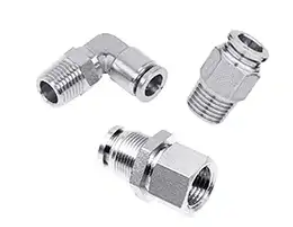
Composite and brass push-in fittings can terminate tubing with the same basic collet-and-O-ring idea, yet body material changes weight, threads, environment and failure modes. Neither choice is complete until the exact tubing and application approval are known.
Begin with the tube system, then compare the body.
Define the push-in interface
Record tube outside diameter, material, wall, hardness and surface tolerance. The collet or grab ring must retain that tube, while the O-ring seals its outside surface.
Cut square, remove damage, mark insertion depth and seat the tube fully. Composite weight or brass strength cannot compensate for a scratched or partially inserted tube.
Some soft tube constructions require an internal support. Use only the support specified for the fitting series.
Evaluate composite bodies by their construction
Composite fittings often combine an engineered polymer body with metal threaded inserts or studs. They can reduce weight and may simplify high-volume assembly.
Actual mass savings depend on size and configuration; a universal 43-percent figure and a fleet fuel claim should not be applied without product and vehicle data. Confirm impact, UV, chemical, temperature and fire behavior for the installed location.
Inspect polymer bodies for cracks, creep, damaged release rings and evidence that a metal port was overtightened.
Evaluate brass bodies by alloy and environment
Brass provides machined threads and a compact metal body for many pneumatic, water and vehicle-air applications. It resists red rust but can still corrode, dezincify or crack in unsuitable chemistry or stress.
Cold-temperature performance and pressure capability are product-specific. Do not claim that all brass remains ductile or corrosion-free under every vehicle environment.
Select configuration after the material
Straight unions, elbows, tees, Y fittings, bulkheads and tube-to-thread adapters solve different routing problems. A mixed-end design can place a push-in tube connection at one port and NPT or another verified port end at the other.
Record end-one/end-two identity and final orientation. An elbow that is tightened by its pipe thread must reach position without backing off or overloading the polymer or brass body.
Verify regulated and high-consequence uses
Vehicle air-brake, potable water, food equipment and other regulated systems require components listed or approved for the exact service. A generic push-to-connect fitting from a shop-air line is not a substitute.
Check current certification, pressure, temperature, media, tube and installation instructions. Preserve product markings and purchasing records.
Composite and brass can both produce useful push-in fittings. The correct choice is the qualified tube-and-fitting system whose body survives the actual route and environment.