
Following Agricultural Fluid Power from Harvest to Handling and Processing
HGW Hydraulics on Feb 12th 2026
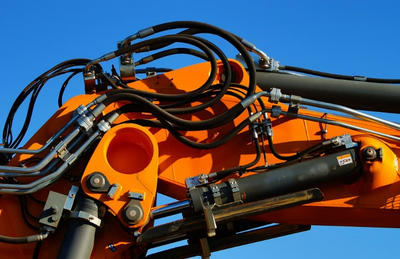
Food production uses fluid power across several distinct environments. Field machines work through dust, vibration, weather, and crop residue. Livestock equipment adds impact, manure, moisture, and frequent washdown. Handling and processing facilities may require different cleanliness, material, and documentation controls.
Calling all of these uses “agriculture” can hide the reasons a connection succeeds in one location and fails in another. The better approach is to follow the product and equipment from field work to storage or processing while preserving each circuit’s requirements.
Harvesters need flexible routing around moving structures
A combine cuts crop, separates grain, cleans it, and transfers it for unloading. Hydraulic functions can lift and position the header, steer, control reel or feeder features, and operate unloading mechanisms. Forage harvesters add spout positioning and feed or cutter functions according to machine design.
Hoses near the header and feeder house move through a large envelope. Dust and stalk material can hide abrasion, while vibration works on clamps and fitting interfaces. Guards should protect identified contact points without preventing inspection or forcing the hose into a tighter bend.
When replacing an assembly, record its installed length and end orientation as well as thread and hose size. A dimensionally correct hose with the wrong angular relationship can twist as soon as it is connected.
Sprayer connections face both motion and chemical exposure
Hydraulics position folding booms, control height, steer, or power auxiliary functions. The liquid-application circuit carries fertilizer, herbicide, pesticide, water, or cleaning media and should not be confused with the hydraulic circuit.
Moisture and chemical residue can attack exposed fittings and plated surfaces. Select materials, coatings, and seals using the actual media and cleaning process. Verify compatibility data rather than assuming one corrosion-resistant finish covers every agricultural chemical.
Inspect low points and shielded areas where residue remains after washdown. A coating damaged by tools or abrasion no longer provides the same barrier as an intact surface.
Livestock equipment adds shock and unpredictable loading
Cattle chutes, gates, squeeze systems, and lift equipment may cycle quickly while animals introduce uneven loads. Cylinders, valves, hoses, and fittings need protection from impact and pinch points. The circuit must also hold or release loads in the controlled way specified by the equipment design.
Face-seal connections may be used where vibration and leakage control are important, but connection family alone does not establish suitability. Pressure, impulse, material, hose construction, assembly process, and routing still have to be qualified.
Before service, restrain or support moving structures and release stored pressure. Animal-handling urgency should not bypass the lockout and mechanical-support procedure.
Telehandlers connect mobile hydraulics with diagnostic access
Telehandlers move bales, pallets, feed, and other loads using boom, tilt, steering, and stabilizer functions. Boom extension changes hose position and load geometry. Test points can help technicians measure pressure without dismantling the primary line, provided the test fitting, hose, and gauge are correctly rated and the procedure defines where and when to measure.
A pressure value alone does not diagnose a slow function. Flow, load, temperature, valve command, and mechanical condition may also be required. Keep test-point caps clean and replace damaged seals so the diagnostic interface does not become a contamination path.
Post-harvest facilities introduce another set of controls
Grain handling, washing, sorting, packaging, and food-processing equipment can use hydraulic, pneumatic, lubrication, water, steam, and process-fluid connections. Materials and seals suitable for a tractor may not satisfy a sanitary or process requirement inside a facility.
Identify whether a connection is in direct product contact, incidental contact, utility service, or a separate hydraulic power circuit. Then apply the facility’s material, cleanability, pressure, temperature, and validation requirements. Do not claim a fitting is food-grade from base material alone.
Field replacement begins with reliable identification
Agricultural equipment can combine North American, British, European metric, and Japanese connection standards. Record the machine, function, both connection ends, thread diameter and pitch, seal location, seat angle, tube or hose dimension, body shape, material, and markings.
Use gauges on clean, undamaged threads and confirm results against a drawing or manufacturer data. Paint, corrosion, and worn seats can make a visual match unreliable. Never use thread sealant to compensate for the wrong flare or O-ring geometry.
Part and lot identification help link a replacement to receiving, inspection, and service history. For a recurring machine family, maintain a verified cross-reference with revision control rather than rediscovering the connection during every breakdown.
Stock according to consequence and replenishment time
Common hose ends, adapters, seals, and protective items may justify local inventory during planting or harvest. Rare configurations may be controlled-order parts if the machine can tolerate the replenishment time. The stocking decision should consider failure frequency, machine criticality, identification confidence, shelf life, and total supply lead time.
Separate similar threads and label open packages. Quarantine a questionable part instead of returning it to the bin. When an incoming batch differs from the approved drawing or sample, isolate the affected lot and resolve the discrepancy before field use.
Agricultural fluid power is a chain of different operating environments, not one application. Following each circuit from machine motion through chemical exposure, livestock handling, diagnostics, and facility processing produces replacements that fit the actual duty instead of relying on a broad industry label.