
Choose Braided or Spiral Hose from the Machine Duty Cycle
HGW Hydraulics on Dec 14th 2021
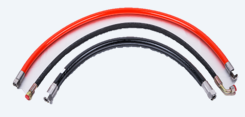
Braided and spiral hose should be selected from the machine’s pressure-time history and route, not from a rule that braid is flexible and spiral is strong. The same reinforcement category includes many constructions, sizes, pressure classes, impulse ratings, and bend limits.
A duty-cycle review reveals whether pressure fatigue, articulation, temperature, or packaging is the controlling problem.
Capture the pressure-time profile
Record normal pressure, load-induced peaks, relief events, rapid valve shifts, cycle frequency, dwell, and expected life. Hydrostatic drives, large excavators, mining machines, presses, lifts, steering systems, and return lines create different pressure histories.
Multi-spiral hose is common in high-pressure, high-impulse applications. One- and two-wire braid covers many mobile and industrial pressure duties. Use the exact hose standard and impulse test rather than assigning all braided hose to low or medium pressure.
Working and burst pressure are different. A safety factor or test ratio belongs to the relevant standard and product, not a universal assumption.
Map motion and the tightest route
Braided hose is often available with tighter minimum bend radius than comparable spiral products, which can help around articulated joints. Yet a particular spiral hose may have improved flexibility, and a larger braided hose can require a broad curve.
Compare published minimum bend radius by exact size and test condition. Include straight tangent behind fittings, hose length change under pressure, twist, clamps, and every machine position. A route that violates the limit should be redesigned rather than solved by choosing a lower-rated hose.
Size changes both pressure capability and packaging
Pressure ratings and bend radii can change across sizes within one hose family. Do not extrapolate a 1/4-inch example to a 1-inch hose. Inside diameter also controls velocity and pressure loss, while outside diameter controls clamps, guards, and available space.
Cylinder return flow can exceed pump flow, and suction lines need adequate absolute inlet pressure. Select each conductor from its actual path, not one hose construction for the whole machine.
Temperature and fluid can override reinforcement choice
The inner tube must match hydraulic fluid, additives, cleaning exposure, and temperature. External cover must resist heat, abrasion, UV, ozone, salt, or chemicals. Pressure ratings may be derated at temperature.
Cold starts increase viscosity and reduce flexibility. High return or throttling losses generate heat. Correct the thermal problem instead of assuming more wire layers protect the elastomer.
The hose end is part of impulse performance
Use stems, ferrules, crimp dimensions, skive instructions, and tooling qualified for the hose series. High impulse loads act strongly at the coupling transition. Inspect insertion, crimp, cover, and bend near the end.
Elbow orientation and assembly clocking should let the hose route without twist. Supports must control movement without crushing the cover or hiding damage.
Compare maintenance and supply constraints
A field team may stock braided assemblies while a high-impulse spiral design requires different tooling and verified components. Availability matters, but it cannot justify a lower specification. Plan common sizes, assemblies, and replenishment before failure.
Record hose series, standard, size, pressure-temperature range, impulse class, bend radius, fluid, cover, fittings, length, clocking, and protection. Inspect the installed route early in service.
Diagnose the failed construction before changing it
A braided hose that loses cover at a rub point did not necessarily fail because braid was inadequate. A spiral hose that leaks near the coupling may have been over-bent, mis-crimped, twisted, or exposed to heat. Preserve the assembly and inspect where damage began.
If reinforcement is fatigued without external damage, compare actual pressure peaks and cycle count with the hose qualification. Verify relief and control behavior, accumulator effects, and whether temperature exceeded the test envelope. A higher static pressure rating may not solve a dynamic impulse problem.
When a change from braid to spiral increases outside diameter or minimum bend radius, check every clamp, guard, and moving position. The stronger candidate can become less reliable if it is forced into the old route.
Apply the choice to a function, not the whole machine
An excavator may use multi-spiral hose for high-impulse boom circuits, braided hose for other pressure functions, and different constructions for pilot, case-drain, or return paths. A factory power unit can combine flexible connections with rigid tube and low-pressure conductors.
Define each line’s purpose and peak flow. A case drain may demand low backpressure more than high reinforcement strength. A suction hose needs vacuum resistance and an unobstructed bore. A return hose sees temperature and peak cylinder discharge.
This function-by-function approach prevents a single dramatic pressure example from becoming the hose specification for every connection.
Validate supplier and batch consistency
For recurring assemblies, approve hose and fittings as a system, capture crimp specifications, and retain lot traceability. Review changes in hose construction, wire source, compounds, cover, manufacturing location, or fitting revision through a controlled process.
U.S. stock can support maintenance only when stored assemblies match the current drawing and shelf-life controls. Long replenishment cycles make accurate forecasts and approved alternates more important, not lower qualification.
The correct hose is the qualified assembly that survives the machine’s pressure cycles while fitting its motion envelope. Braid or spiral describes how reinforcement is arranged; duty-cycle evidence decides which product belongs on the machine.