
Protecting Construction-Machine Hydraulic Connections by Failure Location
HGW Hydraulics on Feb 3rd 2026
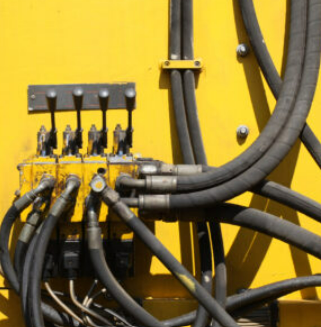
Construction equipment does not expose every hydraulic line to the same hazard. A boom hose flexes, a line under a chassis is struck by debris, a paver works near sustained heat, and an articulated joint combines movement with tight clearance. Effective protection starts by mapping where a hose or fitting can fail, then selecting routing, guarding, material, and inspection practices for that location.
Excavators and dozers combine motion with external damage
Excavators use hydraulics for boom, arm, bucket, swing, travel, and auxiliary attachments. Dozers use cylinders for blade lift, tilt, and ripper functions, with hydrostatic or hydraulic systems in other machine functions depending on design.
Lines near pivots must accommodate the full range of movement without twisting or pulling on a fitting. Hoses routed along structures can rub against clamps, adjacent hoses, or guards as pressure changes their length slightly. Rock, soil, and demolition debris add impact and cutting hazards.
Check the installed line with the attachment in each safe service position. A hose that looks clear when lowered may become tight at full reach.
Crushers, trenchers, and pavers add dust and heat
Long duty cycles raise oil and ambient temperatures. Fine aggregate and dust can enter an open connection during repair and accelerate wear in pumps and valves. External particles also collect beneath clamps and act as abrasive material.
Protect disconnected ports immediately and clean around a connection before opening it. Keep replacement caps and plugs clean rather than reusing contaminated packaging. Verify that seals, hose, and fittings have the required temperature and fluid compatibility; a generic “high-temperature” description is not a rating.
Where a hose approaches an engine, exhaust, hot material, or cooler discharge, compare actual exposure with the hose and guard specifications. A sleeve can reduce one hazard but cannot correct routing that places the assembly against a heat source.
Articulated dumpers and cranes need movement envelopes
Steering joints on articulated dumpers repeatedly bend and rotate hose bundles while mud and debris obscure wear. Cranes add outriggers, boom extension, rotation, winches, and load-holding functions. These circuits may retain stored pressure even after the engine stops.
Use clamps, guides, and guards that control the bundle without crushing it. Allow the designed amount of movement, and keep hoses away from shear points. Before service, support loads and release stored energy using the machine procedure; never rely on a valve lever alone to make a raised structure safe.
Choose protection for the identified failure mode
Abrasion sleeves help separate a hose cover from rubbing surfaces. Spiral guards can provide localized abrasion and impact protection while allowing inspection between turns. Fire-resistant or heat-protective products address specific thermal exposure. Burst-containment or line-of-sight guards are selected where escaping fluid could reach personnel.
These products are not interchangeable and do not increase the hose’s working-pressure rating. Verify material compatibility, temperature range, movement, fastening method, inspectability, and the applicable machine safety requirement. A guard that traps abrasive dirt or hides a damaged fitting can create a different maintenance problem.
Connection style and finish must match the machine
Construction fleets may contain JIC, ORFS, ORB, NPT, BSP, metric, flange, and other connections. Identify thread, pitch, seat, seal, tube or hose size, orientation, and material before ordering. A thread that starts by hand can still have the wrong sealing geometry.
Corrosion control depends on base material, finish, coating condition, chemical exposure, and galvanic contact. Stainless steel or a plated steel fitting may be appropriate in different locations, but neither should be selected from appearance alone. Preserve the approved pressure-temperature rating and evaluate mating materials.
For unusual geometry, a controlled drawing is safer than combining multiple adapters to reach a port. Extra joints add leak paths, length, weight, and bending load. Record revision, dimensions, material, finish, and inspection criteria before manufacturing a special part.
Cleanliness continues through storage and installation
A clean fitting can be contaminated during transport, shelf storage, or field handling. Keep caps and packaging intact until installation, inspect the bore and sealing surface, and use clean tools. If a component arrives uncapped or with visible debris, isolate it for appropriate inspection or cleaning rather than blowing shop air through it.
Lot and part identification make later isolation easier if a dimensional, material, or finish issue is discovered. Store common verified replacements by machine family and keep similar standards physically separated.
Make inspection routes function-specific
Walk the machine by hydraulic function rather than scanning for obvious leaks. Follow supply, work, return, pilot, and case-drain paths. Look for exposed reinforcement, flattened hose, wetness, blistering, hardening, corrosion, loose supports, sleeve damage, and polished rub marks.
Never search for a pinhole leak with a hand. Use the manufacturer’s safe leak-detection procedure and replace an assembly that fails inspection criteria.
Construction-machine reliability improves when protection is tied to a real location and failure mechanism. Routing, guards, clean handling, correct connection identification, and recorded replacement specifications work together; no single sleeve or fitting material can compensate for ignoring the rest of the installation.