
Hose Barb Connections: Matching Tube ID, Barb Geometry, and Retention
Feb 7th 2023
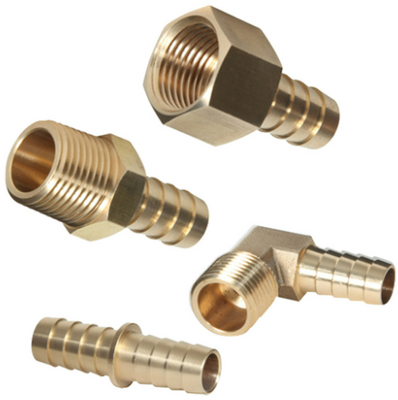
A hose barb is simple only after its dimensions, materials, and retention method have been matched to the tube. The ridges on the stem stretch a flexible hose during insertion. The hose then recovers behind those ridges, producing grip and contact around the stem. That mechanism is useful in many liquid, air, vacuum, and low-pressure circuits, but a connection that merely feels tight is not automatically suitable for service.
The sound selection order is to begin with the hose bore and material, identify the required flow passage and mating thread, then confirm whether the assembly needs a clamp or another positive retention device. This approach avoids treating every serrated stem as interchangeable.
The hose and barb act as one joint
A typical barb fitting has a hollow flow path, one or more raised gripping edges, and a smaller section behind the ridge. As the hose is pushed over the leading slope, its wall expands. Once the edge passes, elastic recovery makes the inside wall press against the stem and resist pull-off.
Soft PVC, rubber, polyurethane, silicone, and other flexible tubing do not all recover in the same way. Wall thickness, hardness, reinforcement, temperature, and fluid exposure change how well the hose conforms. A rigid tube that cannot expand may split; an overly soft or oversized hose may slide off or leak.
Multiple barbs can distribute retention over a longer length. A sharp profile may grip strongly but can cut a vulnerable tube during assembly or cycling. A smoother profile may be appropriate for softer tubing. The fitting design and hose specification therefore need to be evaluated together.
Size the joint from the hose inside diameter
Hose barb sizes are commonly associated with the nominal inside diameter of the hose they are intended to enter. That label is only the starting point. The maximum diameter at the gripping edge, root diameter behind it, insertion length, and internal bore determine how the connection behaves.
The difference between ridge diameter and the shaft is sometimes described as barb depth. Adequate depth helps the hose relax behind the ridge; too much interference can make assembly difficult or damage the liner. Two fittings sold for the same nominal hose can have different profiles, so a drawing or approved sample is more reliable than the size name alone.
Flow also matters. A stem with a restricted bore can create an unwanted pressure drop even when its outside diameter fits the hose. Check the actual passage, especially in suction, vacuum, cooling, beverage, and other circuits where flow loss matters.
Assemble without damaging the tube
Cut the hose squarely and inspect the end for cracks, embedded debris, or reinforcement damage. Push it over the complete barb until it reaches the intended stop. A partially seated hose leaves less gripping area and may place the clamp on the wrong location.
Use only an assembly aid that is compatible with the hose and conveyed medium. Heat, aggressive lubricant, or a tool that scratches the stem can weaken the connection. If a clamp is specified, position it over the supported barb area rather than beyond the stem. Tightening should compress the hose enough to retain it without cutting the cover or collapsing the flow passage.
After assembly, inspect for uniform seating and test the circuit using the applicable procedure. A barb that worked in a static sample may behave differently after temperature cycles, pulsation, vibration, or repeated movement.
Decide whether friction alone is sufficient
Some small low-pressure lines rely on the interference between the hose and barb. Other systems require a worm-drive clamp, ear clamp, crimp sleeve, ferrule, or purpose-designed retention method. Pressure, vacuum, hose stiffness, temperature, pull load, vibration, and the consequence of separation all affect that decision.
Do not assign a pressure capability from the barb style alone. The allowable assembly condition depends on the fitting, hose, clamp, temperature, media, and test requirements. A published rating for one manufacturer’s matched assembly cannot be transferred to a visually similar combination.
Verify both ends before ordering
The barbed end must match the hose, while the other end may be NPT, BSP, JIC, ORB, a sanitary connection, or another interface. Material choice must suit internal fluid and external exposure. Brass, polymer, carbon steel, and stainless steel offer different corrosion, temperature, and mechanical characteristics.
For a replacement, record hose inside diameter and outside diameter, hose type, barb length and ridge count, the opposite-end standard and size, material, clamp style, media, temperature, and operating conditions. Photos beside a scale and an undamaged sample can resolve details that a nominal size cannot.
A reliable hose barb connection comes from controlled interference and correct retention, not from forcing the nearest hose over a serrated stem. When dimensions, materials, and service conditions are documented, the joint can be assembled consistently and replaced without guesswork.