
Where Hydraulics Fit in Hybrid and Electric Construction Machines
HGW Hydraulics on Nov 4th 2025
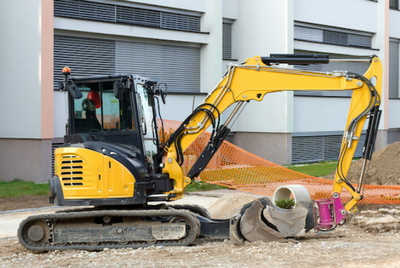
Electrifying a construction machine does not necessarily remove hydraulics. It changes how energy reaches the pump, how unused energy may be recovered, and how the engine can be separated from individual work functions. The useful comparison is therefore not “electric versus hydraulic,” but the complete path from stored energy to traction, lifting, steering, and attachment motion.
Different machines can place an engine, generator, battery, fuel cell, motor, pump, and hydraulic accumulator in very different combinations. The architecture must be evaluated against the machine’s duty cycle rather than a single fuel-saving claim.
Start with the conventional power path
In a conventional excavator, loader, or dozer, an internal-combustion engine drives one or more hydraulic pumps. Valves route pressurized fluid to cylinders and motors, which perform work at the boom, bucket, steering system, fan, tracks, or attachments.
The engine may have to operate at a speed that supports peak hydraulic demand even when the average demand is lower. Throttling, standby pressure, cooling, and transient loads can turn part of the fuel energy into heat. Hybrid designs try to reduce those losses or temporarily supply peak power from another source.
Hybridization can separate engine speed from work demand
An engine-hybrid machine keeps the combustion engine but adds electrical or hydraulic energy storage. A generator can convert engine power to electricity, and electric motors can drive traction systems or hydraulic pumps. The engine may then operate nearer an efficient region while storage supports acceleration, boom lift, or a sudden implement load.
The benefit depends on control strategy. A battery or capacitor that only adds mass without reducing inefficient engine operation will not provide the intended result. Pump controls, motor sizing, thermal management, and software must coordinate the energy sources.
Electrified accessories can also run independently of engine speed. Cooling fans, steering support, or individual pump drives may operate only when demanded, although every added subsystem introduces wiring, connectors, cooling needs, and diagnostic requirements.
Lowering a load creates a recovery opportunity
When a boom or load descends, gravitational energy must go somewhere. A conventional circuit may dissipate much of it across a valve as heat. A hybrid machine may route that energy to an electric generator, a hydraulic accumulator, or another active function.
Engine deceleration and traction braking can offer additional recovery paths. The amount that can be reused depends on timing, storage capacity, conversion efficiency, and whether the next machine action needs the energy. Published savings for one excavator cycle should not be assumed for a loader, crane, or continuously operated attachment.
Fuel cells change the energy source, not the work requirements
A fuel-cell system produces electricity electrochemically and is commonly paired with a buffer battery because construction loads change quickly. Electric motors can then drive hydraulic pumps and traction systems.
This architecture can reduce local exhaust emissions when operating, but a complete evaluation includes hydrogen production, storage, refueling, ventilation, crash protection, system cost, and site infrastructure. Fuel-cell equipment remains a design category with application-specific maturity; it is not a direct drop-in replacement for every diesel machine.
Full-electric machines still have hydraulic interfaces
Battery-electric construction machines can use electric traction while retaining hydraulic cylinders for high-force, compact linear motion. Other designs replace selected hydraulic axes with electromechanical actuators. The choice depends on force density, control, shock loads, duty cycle, space, maintenance, and environmental exposure.
Hydraulic hoses and fittings on an electric machine still face vibration, articulation, debris, temperature cycles, and service handling. A quieter powertrain can make pump, valve, or cavitation noise more noticeable, while high-voltage isolation adds new maintenance boundaries.
Energy storage creates new thermal and service questions
Batteries, power electronics, electric motors, hydraulic oil, and engine coolant may each have a temperature window. A hybrid can reduce one heat source while adding another. Cooling loops, pumps, radiators, filters, and controls should be reviewed as one thermal system.
Maintenance teams also need safe isolation procedures for stored electrical and hydraulic energy. A machine can be switched off while a battery remains energized or an accumulator retains pressure. Lockout, discharge verification, connector protection, and technician training belong in the architecture review.
Evaluate the machine by its work cycle
Record time spent digging, lifting, traveling, idling, lowering, and using attachments. Identify peak and average power, opportunities for regeneration, ambient conditions, charging or refueling access, and required operating hours. Then compare fuel or electricity use, maintenance, cooling demand, payload impact, acquisition cost, and expected service life.
For hydraulic replacements, retain the approved connection standard, material, pressure and temperature ratings, routing envelope, and cleanliness requirements. Electrification does not make a visually similar fitting interchangeable.
Hybrid construction equipment is best understood as energy management around a demanding mechanical duty cycle. Hydraulics remain valuable where compact force and rugged actuation are needed; electric drives and storage can improve how that hydraulic power is supplied when the entire system is designed and controlled together.