
Hydraulic Adapter Selection Starts with Two Complete Connection Definitions
Jul 19th 2023
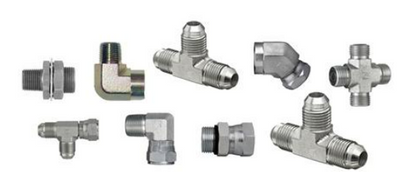
A hydraulic adapter is the boundary between two connection systems. It may change thread family, nominal size, sealing method, direction, or branching. Choosing one by wrench size or port diameter ignores the two surfaces that must retain pressure.
The practical selection method is to write a complete definition for end A and end B, then evaluate the body between them. This separates interface compatibility from routing, flow, and mechanical-load decisions.
Define each end as thread plus seal
An end designation should state standard, size, gender, and seal location. JIC uses a straight UN/UNF thread to clamp a 37-degree flare. ORFS seals with an O-ring on a flat face. ORB uses an O-ring at a straight-thread port. NPT and BSPT use tapered pipe threads under their respective sealing practices. BSPP and many metric straight threads need a specified face, washer, cone, or O-ring arrangement.
Similar thread engagement does not prove the sealing surfaces match. Measure diameter and pitch, determine taper, inspect the seat or groove, and confirm against the equipment drawing or a reliable dimensional table.
An adapter should preserve the correct seal on both sides. Adding tape to a flare or O-ring thread does not substitute for a missing mating surface.
Select body shape from the installed load path
Straight adapters convert an interface or size along one axis. Elbows change direction and can reduce an otherwise tight hose bend. Tees and crosses create branches but also add mass and multiple reaction loads. Reducers and expanders change flow area and may affect velocity and pressure loss.
A swivel that moves during installation can help align a hose without twisting it. It is not automatically a live swivel intended to rotate continuously under pressure. Confirm its function and rating.
Support heavy hose and tube so the adapter is not a structural cantilever. Consider vibration, thermal movement, wrench access, collision clearance, and how the assembly will be serviced. A compact part can still place the hose below minimum bend radius.
Check the bore as well as the end size
Nominal connections do not guarantee an equal internal passage. A reducing adapter, elbow, cross-drilled body, or compact swivel may create the smallest orifice in the circuit. Review the manufacturer’s dimensions when flow, suction performance, response, or pressure drop matters.
Avoid assuming that expanding immediately before a port increases system capacity. Flow remains limited by the narrowest relevant passage and by the rest of the circuit.
Apply service requirements to the complete joint
Maximum working pressure and transient spikes must remain within the rating of the exact adapter and both mating components. Do not transfer a material strength value or burst test from another shape or size. Temperature can change material strength, O-ring behavior, sealant performance, and external loads.
Check internal media and external exposure. Carbon steel may be appropriate with a suitable finish in many hydraulic systems. Stainless steel can improve corrosion resistance in compatible environments but is not immune and requires galling control. Brass and specialty alloys have specific applications; neither color nor cost defines suitability.
For soft seals, specify compound and size. For metal seats, protect surface finish and alignment. Certification or traceability requirements should be agreed before ordering and tied to a defined standard; do not demand a document that the actual application does not require or assume every shipment includes one.
Prevent common replacement errors
Do not copy the old adapter automatically if the previous joint leaked. Confirm whether it was the right standard and whether its length or angle imposed hose load. A mislabeled bin or earlier field substitution can repeat the same problem.
Do not use extra torque to overcome an incorrect pitch or seat. Do not stack several converters where one adapter can provide the defined ends. Do not reuse a cut O-ring or damaged flare because the threads remain clean.
For an unknown assembly, collect photos of both disconnected ends, equipment make and port location, caliper and pitch-gauge results, body orientation, material, media, operating conditions, and hose/tube size. Keep the sample until the new part passes inspection.
Turn the definition into a controlled purchase
A useful adapter line item might read: end A standard and size; end B standard and size; straight/elbow/tee form; orientation if applicable; material and finish; seal material; dimensional constraints; and required records. The supplier can then confirm a drawing or part number rather than infer intent from “JIC to pipe adapter.”
At receiving, compare the actual seats, threads, O-rings, body marking, and key dimensions with that definition. Protect ends with caps and store look-alike standards separately.
Hydraulic adapter reliability is created before the wrench is used. Two complete connection definitions, a body suited to the route, and verified service conditions produce a safer selection than any universal favorite fitting family.