
Specify a Hydraulic Cylinder from the Load Path to the Port Connection
HGW Hydraulics on Jul 14th 2026
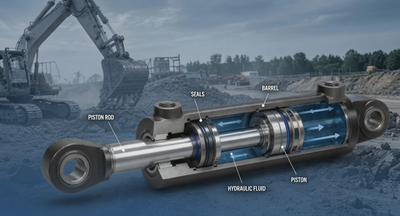
A hydraulic cylinder converts fluid pressure and flow into linear force and motion, but bore and stroke are not enough to specify one. The load path, mounting geometry, rod stability, speed, duty cycle, cushioning, seals, ports, environment, and safe load-holding method determine whether the cylinder will work reliably in the machine.
Selection should begin outside the cylinder—with the moving structure and its worst operating condition—then proceed inward to piston area, construction, sealing, and hydraulic connections.
Define the mechanical work before choosing a bore
Record the required push and pull force across the full stroke. Include load weight, linkage ratio, friction, acceleration, external shock, gravity, wind, material buildup, and the angle at which the cylinder acts. A linkage can require its highest cylinder force at a position that does not correspond to the heaviest visible load.
Ideal extension force equals pressure difference across the piston multiplied by full bore area. Retraction force uses the smaller annular area after subtracting rod area. Real force is lower because of seal friction, backpressure, and other losses.
Do not select pressure merely to make a small bore produce the calculated force. The pump, valves, hose, fittings, ports, structure, and cylinder all need the required rating and design margin. Relief settings and load-induced pressure must be considered separately.
Flow determines speed and return demand
Ideal cylinder speed equals incoming volumetric flow divided by the effective chamber area. Because rod-side area is smaller, a double-acting cylinder can retract faster than it extends at the same flow.
The opposite chamber discharges fluid at a volume rate set by its area and piston speed. Return flow can therefore differ from pump flow. Size the directional valve, fittings, hose, filters, and cooler for the actual path and peak cycle, not only the pump nameplate.
Acceleration, valve ramping, compressibility, air, internal leakage, and load motion affect measured cycle time. Fast speed also increases kinetic energy that must be stopped near the end of stroke.
The barrel and piston form two pressure chambers
The barrel provides the finished bore in which the piston travels. Bore roundness, surface finish, straightness, material, and wall design affect sealing and pressure integrity. The piston separates chambers and carries the piston seal, wear bands, or guide elements according to design.
Ports admit and discharge fluid. Their thread family, seal, size, location, and orientation affect pressure loss and hose routing. Port connection should be identified by the actual standard and drawing; NPT, SAE O-ring boss, BSP, metric, and flange arrangements are not interchangeable.
The cap or base closes one end and commonly carries a mounting feature. The head or gland closes the rod end, guides the rod, retains seals and wiper, and may be removable for service. These names and construction details vary by manufacturer.
The rod carries force and resists instability
The piston rod transfers cylinder force to the machine. Diameter selection must address tension, compression, bending, threads, attachments, and buckling. A long extended rod under compression can become unstable before the piston reaches the theoretical pressure force.
Buckling analysis depends on unsupported length, end constraints, material modulus, geometry, alignment, and load. A larger bore does not correct an undersized rod or poor mount arrangement.
Chrome plating or another rod surface system can reduce wear and corrosion for a defined environment, but surface damage, weld spatter, impact, salt, or abrasive contamination can cut seals. Inspect the exposed rod and protect it where the application requires boots, bellows, guards, or a different surface treatment.
Seals must match fluid, temperature, motion, and pressure
Piston seals control internal leakage between chambers. Rod seals retain fluid at the gland. Wipers limit external contamination entry, while wear rings or bearings guide moving parts and prevent metal contact.
Elastomer or polymer family alone is insufficient. Compound, hardness, geometry, extrusion gap, surface finish, speed, pressure, temperature, fluid, and dwell time interact. Fire-resistant fluids, biodegradable oils, water glycol, low temperature, or high-frequency cycling may require a different package from general mineral-oil service.
Some leakage or drift may originate in a directional or load-holding valve rather than the cylinder seals. Diagnose the circuit before rebuilding the cylinder.
Choose construction for service and packaging
Tie-rod cylinders use external rods to clamp heads and barrel together. They can be serviceable and are common in industrial machinery; standardized mounting envelopes may be available within particular product systems.
Welded-body cylinders join major body elements by welding and can provide a compact envelope for mobile equipment. Weld design, material, process qualification, distortion control, and service method matter. “Welded” does not automatically mean a longer life than every tie-rod design.
Mill-duty, threaded, bolted, and custom constructions address other force, environment, or maintenance needs. Select from verified specifications rather than the broad body label.
Single-acting and double-acting describe fluid control
A single-acting cylinder receives pressure for motion in one direction and returns through gravity, spring force, or external load. It still needs controlled venting, contamination protection, and safe behavior if pressure is lost.
A double-acting cylinder uses pressure on either side of the piston for extension and retraction. It offers powered motion in both directions but requires directional control of two paths.
A spring-return cylinder is not automatically fail-safe, and a double-acting cylinder does not by itself hold a suspended load. Use engineered load-holding valves, mechanical supports, brakes, or locks as required by the risk assessment. Leakage through a valve or seal can permit movement.
Telescopic cylinders trade compact retraction for staged behavior
A telescopic cylinder nests multiple stages to create long travel from a short retracted package. Dump bodies, refuse equipment, lifting systems, and other machines may use single-acting or double-acting versions.
Stage areas differ, so speed and available force can change as stages sequence. Side load, overlap, extension order, bleeding, porting, and mounting are critical. Specify required extended length, retracted length, stage sequence, force throughout travel, and permitted load direction rather than only total stroke.
Mounting determines whether the load stays axial
Clevis, trunnion, flange, foot, spherical-bearing, and pin mounts constrain the cylinder differently. A pivoting cylinder needs compatible pivots at the machine and load so it can align through the arc. A rigid mount needs structure that maintains alignment.
Hydraulic cylinders are designed primarily for axial load. Side load can wear bearings and seals, score the barrel, bend the rod, and loosen mounts. Machine guides should carry transverse forces rather than asking the cylinder rod to act as a structural rail.
Check pin shear and bearing stress, lug strength, welds, fastener preload, bracket deflection, and clearance through the entire stroke. Lubrication and retention of mounting pins belong in the maintenance plan.
End-of-stroke energy needs a stopping method
If a moving mass reaches the end cap at speed, impact can damage the cylinder and structure. Fixed or adjustable cushions restrict discharge near the end of travel to decelerate the load. External shock absorbers, valve ramps, reduced flow, or mechanical stops may be required for higher energy.
Cushion performance depends on mass, speed, pressure, oil viscosity, orientation, and cycle. It is not a universal soft stop. Confirm adjustment and thermal behavior during commissioning.
Avoid using the cylinder’s internal end as the machine’s repeated precision stop unless the design explicitly supports it.
Environment and sensing change the specification
Construction, agriculture, mining, marine, foundry, food production, and indoor automation expose cylinders to different dust, chemicals, water, temperature, impact, and cleaning. Select rod treatment, paint or coating, base material, wiper, seals, guards, and drainage for the actual environment.
Position sensors may be external, magnetostrictive, proximity-based, or integrated by other methods. Define accuracy, resolution, repeatability, electrical interface, ingress protection, temperature, cable routing, and safe failure behavior. Sensor integration does not remove the need for mechanical stops or pressure protection.
Document the connection and replacement envelope
For a replacement, record manufacturer and model, bore, rod diameter, stroke, retracted and extended pin-to-pin dimensions, mount style and dimensions, port standard and position, working and proof requirements, speed, fluid, seals, cushion, sensor, paint or material, and orientation.
Photographs help but do not reveal internal construction or rating. A cylinder that fits between pins can still have the wrong port, rod strength, seal package, or pressure capability.
Check hose motion at both ends. Port adapters should not create a lever arm that loads the port or a restriction that changes speed and backpressure. Use a controlled drawing when replacing an obsolete or custom cylinder.
Match common symptoms to the complete axis
External rod-end leakage can involve a worn rod seal, but a scored or corroded rod, damaged wiper, misalignment, contamination, excessive side load, or pressure spike may be the initiating cause. Replacing seals alone can produce a short repeat failure.
Cylinder drift can come from piston-seal leakage, a directional valve, a counterbalance or load-holding valve, thermal change in trapped fluid, or movement in the mechanical linkage. Use a safe isolation test approved for the circuit rather than disconnecting and capping lines casually.
Jerky motion can involve trapped air, stick-slip seals, contamination, poor valve control, mechanical binding, changing load geometry, or insufficient inlet flow. High temperature can come from throttling or internal leakage elsewhere even when the cylinder is the visibly slow component.
Bent rods, damaged bearings, cracked mounts, and repeated seal extrusion are evidence that force, alignment, pressure, or geometry deserves review beyond a seal kit.
Plan repairability before the machine is built
Provide access for pin removal, gland service, hose tools, sensor replacement, and safe mechanical support. Ensure a cylinder can be removed without cutting unrelated structure or placing technicians beneath an unsupported load.
Decide which seals, bearings, pins, and adapters will be stocked and how their revisions are controlled. A replacement seal kit should match the cylinder serial or design revision, fluid, and temperature—not only bore diameter.
For outsourced or overseas cylinders, define drawing control, approved material and seal sources, first-article inspection, weld and pressure-test requirements, marking, cleanliness, packaging, and batch traceability. U.S. inventory can reduce replacement time only when the stored configuration matches the machine revision.
Commission and maintain the complete axis
Flush and cap lines according to the cleanliness procedure, install the cylinder without forced alignment, and use specified pin and fastener practices. Fill and bleed the circuit using the manufacturer’s method; trapped air can cause erratic motion and unexpected compression.
Begin at controlled load and speed. Verify direction, leakage, pressure, temperature, cushion, sensor response, clearances, hose routing, and load-holding behavior. Reinspect mounts and connections after the defined initial period.
Trend rod condition, drift, cycle time, seal leakage, pin wear, temperature, and fluid cleanliness. Before service, lower or mechanically support the load and relieve, isolate, or restrain hydraulic energy. Never rely on the cylinder alone beneath raised equipment.
A hydraulic cylinder is one axis inside a machine, not an isolated tube and piston. Starting with the load path and following force, flow, mounting, stability, sealing, environment, ports, and safe control produces a specification that can be purchased, installed, and maintained without guesswork.