
Define a Hydraulic Adapter by the Two Interfaces It Bridges
HGW Hydraulics on May 27th 2021
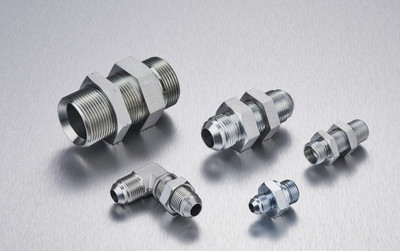
Field language often calls every small connector a fitting. “Adapter” is most useful when a component bridges two sizes, genders or connection standards. This is a functional distinction, not a universal industry rule that places every part into one exclusive category.
Describe the two pressure boundaries
A hose end may connect directly to a matching port. An adapter can instead join JIC to NPT, ORFS to ORB, metric to BSP or another pair. Each side keeps its own sealing principle.
Write descriptions in a consistent end-one/end-two order, including male or female, size, thread and seat. “ORB by JIC” without genders, orientation or body shape can still be ambiguous.
Add routing function after interface identity
Straight unions preserve direction. Elbows turn a line, tees create branches, reducers change nominal size and bulkheads cross panels. Swivels support assembly or intended motion depending on design.
The body affects centerline, bore and wrench access. Replacing an elbow with a straight conversion can force a hose below minimum bend radius even when both threads are correct.
Branching parts need an unambiguous port map. For a tee, identify the run ends and branch rather than assuming every catalog lists them in the same sequence. For an elbow, note whether a male stud end is adjustable and how the final orientation is locked.
Count the new load and leak locations
An adapter may remove an incompatibility while adding length and another joint. A stack can magnify vibration and side load at the machine port. Use a purpose-designed special when it reduces demonstrated risk and has an engineering basis.
Do not add adapters to conceal an unidentified thread. A near match may start by hand, damage the female port and leave both sides harder to identify.
Preserve material and rating across both ends
Pressure capability comes from the finished geometry, size, alloy, temperature and product qualification. The adapter should not be assumed to carry the higher rating of either mating component. Bore reduction may also add pressure loss.
Corrosion and seal material need zone-specific review. Stainless body material cannot repair an incompatible O-ring, washer or flare.
Decide whether conversion belongs at the machine or conductor
Placing one adapter at a machine port can let several replacement hoses use a locally common end. In other systems, a direct hose end reduces joints and installed height. The better choice depends on service access, hose availability, port strength, cleanliness controls and whether repeated hose changes would wear the equipment port.
For an imported machine, record the original port and the U.S.-stocked conductor separately. That record lets purchasing replace the consumable hose without guessing which transition was built into the previous assembly.
Do not create a chain of reducers to avoid sourcing the correct part. Besides increasing possible leak points, a stack can block a wrench, shift the hose centerline or concentrate bending at a small port.
Build a replacement record
Capture both mating components, seal locations, installed angle, clearance, fluid, pressure and failure evidence. If routing strain caused the original leak, correct supports or geometry as part of the replacement.
The term adapter earns value when it forces the buyer to verify two complete interfaces. Whether a catalog calls the part a fitting or adapter is less important than making both seals deliberate and traceable.