
Reading Hydraulic Hose Markings and Building the Correct Ferrule Connection
HGW Hydraulics on Jan 11th 2022
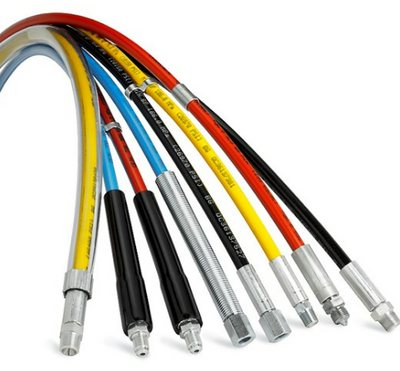
Color on a hydraulic drawing, printing on a hose cover, and paint or labels used in a shop do not mean the same thing. Drawing colors help an engineer follow circuit function. A hose layline identifies the product and its ratings. A maintenance color may identify a machine circuit. None of those colors, by themselves, tells a technician which stem, ferrule, crimp diameter, or skive process belongs on the hose.
That distinction is important because a hose end is a matched assembly. The tube, reinforcement, cover, fitting stem, ferrule, and crimp specification are designed to work together. Reading the hose correctly is the first step; using the approved assembly data is what makes the connection.
Three kinds of color information appear around hydraulic hose
Hydraulic circuit diagrams sometimes use colors to distinguish pressure flow, return flow, pilot signals, suction lines, or other functions. JIC and ANSI conventions have influenced schematic practices, but the drawing legend controls the meaning on a specific machine. The same physical hose product may be installed in more than one circuit function, so a diagram color is not a hose material specification.
Some manufacturers use colored layline elements or colored covers to distinguish constant-pressure hose families. ISO 18752 classifies hose by performance criteria that include pressure, temperature, and impulse requirements. A manufacturer's colors can make warehouse and assembly identification faster, but the color key belongs to that product system. It should not be assumed to match another brand or an older revision.
Finally, equipment owners may add colored bands, sleeves, or tags for service identification. That can help trace paired lines during replacement, especially when several hoses run through one boom or manifold area. The local marking should remain separate from the original layline so the hose specification is still readable.
The layline is the starting record
Before removing a failed hose, photograph the layline and both end connections. Useful markings can include the manufacturer, hose family, standard, dash size, pressure information, manufacturing code, and other traceability details. Not every hose shows every item, and worn covers may make part of the line unreadable.
When markings are incomplete, combine the remaining layline with actual dimensions and machine documentation. Measure the hose inside-diameter basis through the identified dash size or product table, record outside diameter for ferrule selection, and identify the reinforcement and cover. Do not choose a replacement solely from cover color or outside diameter.
Hose standards do not eliminate manufacturer-specific assembly requirements. Two hoses that meet a broad performance class can use different cover thicknesses, reinforcement packages, fitting stems, ferrules, or crimp settings.
One-piece and two-piece ends organize components differently
A one-piece hose end arrives with its ferrule attached to the stem. This reduces the chance that an unrelated loose ferrule is selected from a bin and can simplify field inventory. It does not make the fitting universal; the complete end still has to be approved for the exact hose series and assembled to the specified crimp diameter.
A two-piece end uses a separate stem and ferrule. That architecture can cover hose families where the correct ferrule changes with construction, reinforcement, or skive requirement. It also increases the importance of part-number control because the stem and ferrule must be matched to each other and to the hose.
Do not mix hose, stem, and ferrule components merely because their dimensions appear to fit. Assembly performance depends on how the stem supports the hose bore, how serrations engage the tube and reinforcement, how the ferrule controls the cover, and how the crimp changes those interfaces. Use the current assembly table from the responsible manufacturer or validated system owner.
Skiving is a specified preparation, not a quality grade
Skiving removes a controlled amount of hose material near the end before the fitting is installed. External skiving removes cover to expose or approach the reinforcement so a specified ferrule can engage it. Internal skiving removes inner-tube material when a particular hose-and-fitting design requires direct stem contact with reinforcement. Some assemblies require both; others require neither.
A skived connection is not automatically stronger than a no-skive connection. Modern no-skive systems are engineered so the stem and ferrule develop the required grip through the intact cover. Removing material from a no-skive hose can damage the design just as failing to skive a skive-required hose can prevent correct engagement.
Use proper skiving equipment and the prescribed diameter and length. A hand cut that is too deep can damage reinforcement wires; one that is too short can hold the fitting away from its intended position. Loose rubber and wire fragments should be removed before assembly so contamination is not carried into the line.
The crimp process proves whether the parts were identified correctly
Once the hose, stem, and ferrule are confirmed, follow the specified insertion depth, die set, crimp diameter, and measurement location. Marking the insertion depth can show whether the hose moved during crimping. Measure the finished diameter with the method defined for that system rather than at a convenient high or low point.
Visual checks should look for exposed or damaged wire, a split ferrule, incorrect stem position, cover bunching, and contamination. Where the assembly procedure calls for proof testing, cleaning, capping, or a documented inspection, complete those steps before the hose enters inventory or returns to the machine.
Traceability connects the physical assembly to the data used to build it. A shop record can include hose and fitting part numbers, crimp specification revision, finished measurement, assembler, date, and any required test result. That record is more useful than a color alone when a later failure has to be investigated.
Keep the marking system useful in service
Route the new hose so the layline remains visible where practical, but do not twist the hose merely to present the printing. Add equipment identification without covering essential manufacturer markings. If paired hoses could be reversed, label both ends consistently before disconnection.
Schematic colors help people understand the circuit. Laylines help identify the hose. Shop labels help trace the installed route. Ferrule and skive data define the end connection. Keeping those systems separate, and then linking them through a controlled assembly record, reduces wrong-part substitutions without relying on a color code that was never intended to carry the whole specification.