
Cross-Reference Hydraulic Hose by Application Limits, Not Brand Series
Apr 26th 2023
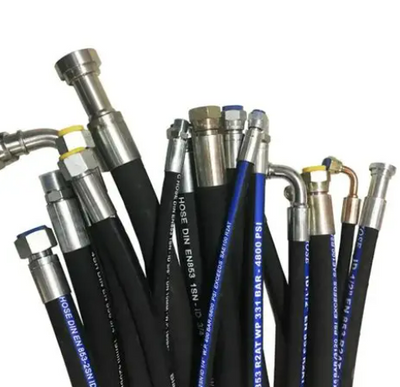
A hydraulic hose cross-reference is not a declaration that one manufacturer’s series is equivalent to another. It is a documented comparison showing that a proposed hose-and-fitting system meets every controlling requirement of a particular assembly. A common SAE category is a useful starting filter, not the final approval.
Capture the incumbent assembly before searching
Record the hose layline, manufacturer and family, size, length, end connections, orientation, date information, and machine location. Retrieve the current technical data when possible. The removed hose also provides evidence about abrasion, heat, impulse, chemical exposure, bend, twist, and coupling condition.
Add operating facts: continuous and peak pressure, temperature, fluid, flow, vacuum, movement, external environment, cleanliness, and consequence of failure. Without those details, a cross-reference can only compare catalog labels.
Use SAE J517 categories as construction clues
SAE 100R1-type hose is commonly associated with single-wire-braid construction; 100R2 uses two wire braids. Compact braided categories such as 100R16 can offer different bend behavior and size-specific pressure capability. Multi-spiral families such as 100R12 and 100R13 serve demanding pressure and impulse applications. Textile-reinforced 100R3-type hose can be used in suitable lower-pressure service.
These descriptions do not create one universal pressure. Ratings vary by standard category, dash size, manufacturer construction, temperature, and assembly. Correct designations are 100R12 and 100R13, not shortened numbers that omit the R.
Compare the data field by field
For each candidate, compare:
- inside and outside diameter;
- size-specific working pressure and applicable temperature derating;
- minimum bend radius and change in length;
- fluid and ambient-temperature compatibility;
- reinforcement and impulse qualification;
- cover abrasion, ozone, weather, and fire-related requirements;
- vacuum, static, permeation, or special application limits;
- approved coupling family, crimp data, preparation, and tooling.
A candidate with a higher pressure rating can still be wrong if it is too stiff, too large for clamps, incompatible with the fluid, or not qualified with the shop’s ends. A lower bend-radius number does not prove equal impulse life or cover performance.
Cross-reference the finished ends separately
Hose standards do not identify JIC, ORFS, ORB, NPT, BSP, metric, or flange ends. Verify both connections, sealing faces, material, orientation, and adapter arrangement. A brand change may require a different stem and ferrule even when the port end looks identical.
Do not crimp a new hose onto used permanent couplings or mix hose and fitting brands unless the responsible manufacturer or engineering authority has expressly qualified the combination. Record crimp diameter, insertion, die, machine, inspection, and traceability under the applicable procedure.
Validate high-risk replacements before fleet use
For recurring or critical assemblies, review samples for fit, routing, movement, and guarding on the machine. Perform proof, cleanliness, or other testing required by the design and hose-assembly program. Monitor early field results and retain the original option until the substitution is approved.
Low-pressure return or suction service deserves the same discipline. Vacuum resistance, collapse, oil compatibility, temperature, and connection retention can control the choice even when pressure is modest. Installing severe-duty spiral hose everywhere can add cost and routing problems without solving those requirements.
Keep the cross-reference revision controlled
Technical data and product series change. Store the source and candidate document revisions, approved sizes, exclusions, fitting system, and authorization. If one dash size fails a requirement, do not extend approval from adjacent sizes.
A useful cross-reference lets purchasing source alternatives without guessing and lets technicians build the same qualified assembly later. It compares measurable application limits and components; it never relies on a competitor name, a similar cover color, or an unverified claim of brand-wide equivalence.