
Hydraulic Hose End Selection by Material, Attachment Method, and Seal
Dec 27th 2022
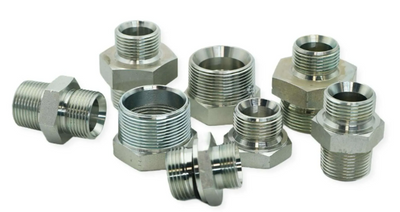
A hose end has to satisfy two interfaces: it must attach securely to the hose, and it must seal correctly to the machine port or mating fitting. Material selection affects corrosion, strength, temperature, and galling; attachment method controls how the stem and ferrule grip the hose; connection geometry determines where fluid is sealed.
Choosing only by thread name or metal type leaves two-thirds of the assembly unspecified.
Material follows the fluid and external environment
Plated carbon steel is widely used for hydraulic hose ends because it combines mechanical strength with economical production. Coating condition and environmental exposure matter where moisture, salt, chemicals, or abrasion can remove protection.
Stainless steel can improve corrosion resistance in compatible environments, but alloy grade and service chemistry must be defined. Brass and aluminum serve selected fluid, pneumatic, mobile, or weight-sensitive applications when their exact ratings and compatibility support the use. They should not be assigned a general low-, medium-, or high-pressure category from material name alone.
Engineered polymers can provide chemical resistance and low weight in appropriate low-pressure or pneumatic systems. “Plastic” does not mean universal corrosion immunity; temperature, solvent exposure, creep, ultraviolet light, and connection design remain limits.
Permanent crimp ends form a matched assembly
A crimp fitting uses a stem inside the hose and a ferrule compressed around the outside. One-piece ends combine stem and ferrule before assembly. Two-piece systems use a separately selected ferrule.
The hose, stem, ferrule, crimp diameter, dies, and any skive instruction must come from a validated combination. The ferrule does not merely squeeze the cover; the design controls how load is transferred through the hose tube and reinforcement.
Crimped ends are common where repeatable shop assembly and compact permanent retention are needed. Once removed, the crimp end and cut hose section are not reassembled as though new.
Field-attachable ends solve access problems under defined limits
Reusable or field-attachable fittings often use a socket threaded onto a compatible hose and a stem installed into that socket. Hand-tool assembly can support remote service where a crimper is unavailable.
The term “reusable” does not make one end compatible with every hose or guarantee unlimited reuse. Follow the listed hose type, insertion and wrenching procedure, inspection criteria, and component replacement rules. The fitting must still meet the application's pressure, temperature, impulse, and media requirements.
Identify the external seal independently
NPT and NPTF use tapered pipe-thread systems. JIC uses a 37-degree flare seat. ORFS seals with an O-ring at a flat face. ORB seals an O-ring at a straight-thread port. BSP and metric families include several parallel, tapered, cone-seat, and O-ring arrangements.
Record thread diameter and pitch, male or female, seat angle or face, O-ring location and material, and orientation. An O-ring connection is not automatically rated above a metal-seat fitting; capability varies by size, material, design, temperature, and manufacturer.
Over-torque can damage threads, seats, O-rings, or component ports. Under-tightening can leave insufficient clamp load. Use the assembly procedure for the exact connection instead of one shop-wide torque rule.
Complete the selection with application data
Pressure includes normal operation and expected transients, with the assembly limited by its lowest-rated component. Temperature includes fluid and ambient conditions. Media compatibility covers hose tube, fitting body, plating, O-rings, and cleaning chemicals.
Application adds vibration, impulse, bending near the end, abrasion, routing, and service frequency. Size includes hose inside diameter, fitting bore, and any effect on flow. The end connection must match the actual port, not merely the previous part description.
For replacement control, preserve manufacturer and part identification, approved hose combination, crimp or assembly specification revision, and both connection ends. That record is more reliable than selecting from a list of well-known manufacturers or assuming similar products share dimensions.
The correct hose end is a complete material-and-interface specification. When material, hose retention, external seal, and operating conditions are evaluated together, the assembly can be built and traced without relying on brand familiarity or visual similarity.